

Review · OLD TOWN WALKING TOURS
Dubrovnik Old Town Walking Tour
Dubrovnik makes sense fast on foot. This 1 hour 30 minute guided walk through the Stari Grad (Old Town) helps you connect the dots between streets, buildings, and the stories that made this walled city famous. You get a local guide and a clear route that hits the big visual hits without turning your day into a stair marathon.
I especially like how the tour starts at Pile Gate, right where you naturally enter Old Town, so the history feels anchored in the actual layout you will walk later on your own. Another standout is the stop-by-stop focus on smart details, like Onofrio’s Fountain and the water system that fed the city for centuries.
One drawback to plan for: it depends on good weather, and you will be outside on uneven stone. If you are sensitive to sun or long standing, come ready with water and think about pacing yourself at each stop.
In This Review
- Key highlights to look for
- Entering Old Town at Pile Gate
- Onofrio’s Fountain: more than a pretty stop
- Franciscan Monastery cloister: a quieter side of town
- Stradun and the rhythm of the main street
- Sponza Palace: where power and records lived
- Orlando Column and the strange clock detail
- Rector’s Palace and the Church of St. Blaise
- Dubrovnik Cathedral of the Assumption: Baroque rebuilt after disaster
- What the tour is like on the ground
- Price and value: why $31.46 can feel like a bargain
- Who should book this walking tour
- Small practical notes before you go
- Should you book the Dubrovnik Old Town Walking Tour?
- FAQ
- How long is the Dubrovnik Old Town Walking Tour?
- Where does the tour start and end?
- What language is the tour offered in?
- What is included in the price?
- How large is the group?
- What should I see during the walk?
- What if the weather is bad?
- Can I get a refund if my plans change?
Key highlights to look for

- Pile Gate start: A practical point of entry into Stari Grad, so you get your bearings quickly.
- Onofrio’s Fountain and the aqueduct: A memorable water story tied to the city’s early infrastructure.
- Franciscan Monastery cloister: A calm pause with a Gothic setting and art you would likely miss.
- Orlando Column clock detail: A strange, fun feature you can spot on the walk and remember later.
- Sponza Palace and civic power: You see how administration and daily life were connected in the same spaces.
- Cathedral of the Assumption: A Baroque interior you visit after learning why the original was rebuilt.
Entering Old Town at Pile Gate
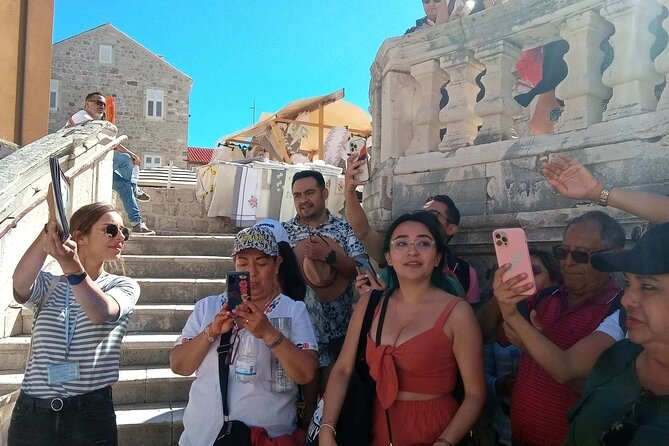
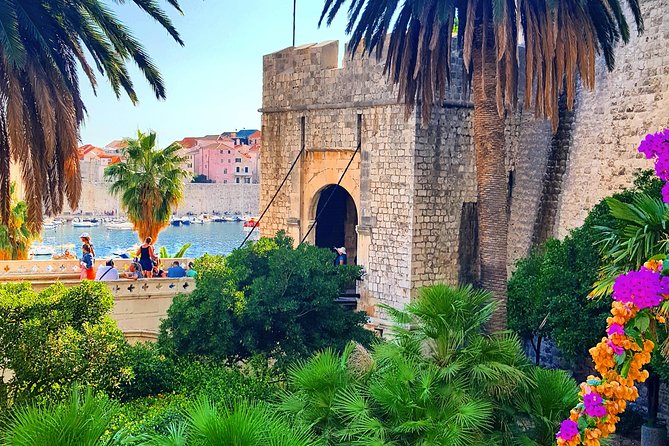
Most Dubrovnik tours can feel like you are thrown into crowds first and history second. This one flips that. You meet at Elite Travel Walking Tours at Brsalje ul. 1, and the walking begins at Pile Gate, one of the key western entrances into Stari Grad. That matters, because Dubrovnik’s Old Town is easy to get turned around in once you are inside the walls.
As you start, you also get an immediate sense of scale. The old limestone streets guide your eye toward the landmarks without you having to study maps. The guide’s pacing helps you learn what is important and what is just decoration. That is the kind of “take the stress out of it” value that makes a short tour feel longer in the best way.
The group size is kept small, with a maximum of 16 travelers. That usually means you can ask questions and actually hear the answers, especially if your guide takes brief pauses at the better stopping spots.
More Old Town Walking Tours in Dubrovnik
- Dubrovnik: Old Town Walking Tour
★ 4.8 · 5,174 reviews - Dubrovnik Discovery Old Town Walking Tour
★ 5.0 · 4,458 reviews - Dubrovnik Old Town History Walking Tour
★ 5.0 · 1,684 reviews
Onofrio’s Fountain: more than a pretty stop
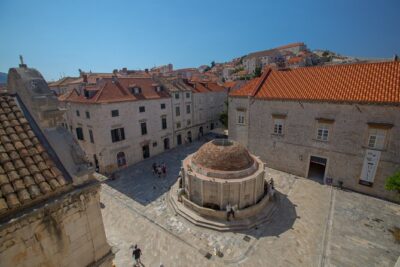
Right after Pile Gate, you reach Onofrio’s Fountain, the classic multi-faucet drinking fountain connected to an aqueduct. The guide explains that the aqueduct ran from a spring roughly 7.5 miles (12 km) away, bringing drinking water into the city for centuries. That is not just trivia. It tells you how Dubrovnik worked day to day.
What I like about this stop is that it reframes the Old Town from “walls and views” into “engineering and survival.” If you have ever wondered how a dense walled city managed water, this is where the answer becomes visual. You are not reading a history panel. You are standing next to the thing that made life possible.
The fountain also gives you a natural photo pause, and it is early enough in the walk that you are still fresh. If you are traveling in peak season, getting this landmark early can mean a smoother experience before the Old Town feels like it is at capacity.
Franciscan Monastery cloister: a quieter side of town
Next comes the Franciscan Monastery and church area, where you can slow down. This is one of those stops that changes the mood of the walk. You move from the open flow of the street into a more contained atmosphere, and the guide points out why that matters for the city’s spiritual and cultural life.
Inside the monastery setting, you also hear about the 14th-century Gothic cloister and see art that is part of the complex’s long life. One detail worth paying attention to is the connection to pharmacy history. The monastery is known for one of the oldest still-functioning pharmacies in Europe. Even if you are not a museum person, that fact makes the building feel real and lived-in rather than just old.
A practical tip: this stop is ideal if you want a bit of shade and a chance to reset your feet. Dubrovnik’s stones heat up fast. The guide often times stops so you can catch calmer moments, and the cloister helps with that.
Stradun and the rhythm of the main street
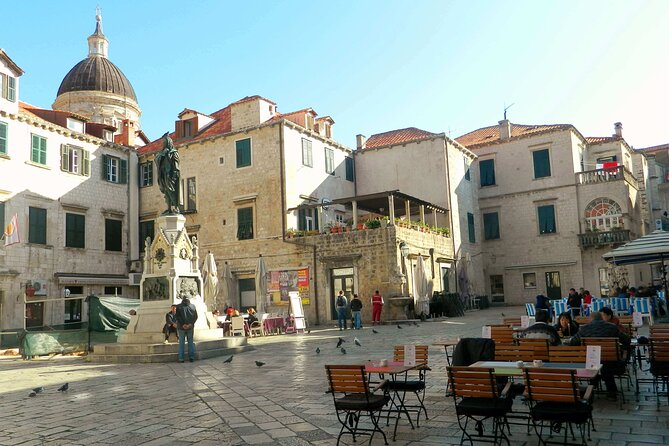
From the monastery area, you head toward Stradun, the limestone-covered main pedestrian street of Dubrovnik. Stradun can look almost too perfect from a distance, like a stage set. Up close, it becomes a timeline of how commerce, power, and public space were arranged.
This is where you learn how to “read” the Old Town. The guide directs your attention to architectural contrasts and street-level cues. You start spotting details on your own: arch shapes, how buildings relate to the street, and where the city’s main civic functions clustered.
If you plan to do the walls on another day, Stradun is a great warm-up. You will recognize sections of the city once you have seen the street layout from ground level.
More Walking Tours in Dubrovnik
- Dubrovnik: Game of Thrones Walking Tour
★ 5.0 · 1,732 reviews - Dubrovnik: City Walls Early Morning or Sunset Walking Tour
★ 4.8 · 1,523 reviews - Dubrovnik: Ancient City Walls & Wars Walking Tour
★ 5.0 · 1,270 reviews - Dubrovnik: City Walls, Old Town Walking Tour & Adriatic View
★ 4.9 · 982 reviews
Sponza Palace: where power and records lived

A key civic stop on this walk is Sponza Palace, a Renaissance highlight that now houses the State Archives. The guide explains the significance of the building in terms of public administration. Even if archives are not your thing, the location helps you understand how Dubrovnik organized itself.
Sponza is also a “stop and look up” moment. The way the palace sits along the main route makes it a natural waypoint. It helps you connect your walk to a bigger idea: this city was built to function, not just to impress.
This is the kind of stop that pays off later. If you spend the rest of your trip exploring on your own, you will remember where the archives are and understand why that part of the Old Town feels like a center.
Orlando Column and the strange clock detail
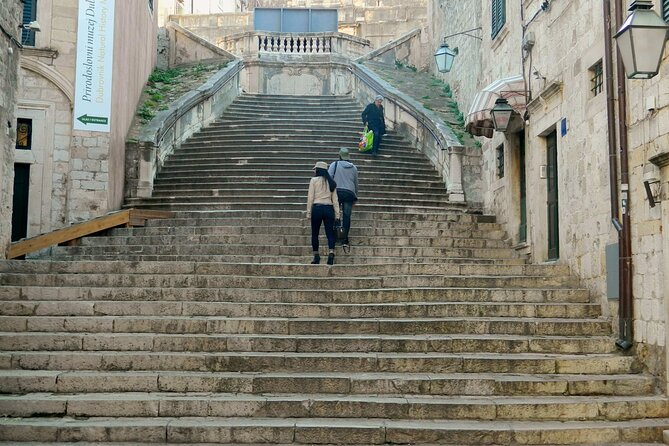
Now for a quirky landmark that is easy to miss without context: Orlando Column. The guide points out that it features a clock tower element that shows the time in Arabic and Latin numerals, and it only changes every five minutes.
That may sound like a trivia detour, but it’s exactly the kind of story that keeps a short tour memorable. It also helps you slow down and observe. You are not just walking through a famous square. You are learning to notice what makes Dubrovnik specific.
If you like street-level oddities and the “why is that there” kind of facts, this will land well. It gives you a detail to look for again later, whether you are photographing or just wandering.
Rector’s Palace and the Church of St. Blaise

Across the main square area, you see Rector’s Palace and Church of St. Blaise, Dubrovnik’s patron saint. These stops help connect the city’s civic and spiritual identities. The Rector’s Palace side gives you a sense of how leadership and governance were displayed in stone. The church side shows the religious center of community life.
One useful thing your guide can do here is explain why these buildings are not separate from the everyday street experience. They are part of the same public geography. You will likely start to recognize where people would have gathered, not only where tourists now stand for photos.
Also, if you are deciding which sites to prioritize later, the St. Blaise and Rector’s Palace area is a good anchor point. You can decide after the tour whether you want more time in the cathedral surroundings.
Dubrovnik Cathedral of the Assumption: Baroque rebuilt after disaster
The final major highlight on this walk is Dubrovnik Cathedral of the Assumption, a Baroque sanctuary built in the 18th century after an earthquake destroyed the original. The guide’s framing matters here. Without that context, you might see only the ornate façade and think it is just another historic church.
But knowing it was rebuilt after a disaster changes how you look at the whole site. It becomes a statement of resilience, and you start noticing the deliberate character of the Baroque response.
The cathedral stop is also a strong way to end a short tour because it feels like a culmination. You have moved from gates and water infrastructure to monastery cloisters and civic palaces. Then you arrive at a major spiritual centerpiece and understand why it is still the city’s identity marker.
What the tour is like on the ground
This is a morning start at 10:30 am, and that timing is usually a big deal in Dubrovnik. You get to the key highlights while the air is cooler and before the late-day crush. The benefit is practical: you spend your time learning, not just fighting crowds.
The tour runs about 1 hour 30 minutes, which is a sweet spot for an orientation walk. It is long enough to make the Old Town feel navigable, short enough that you still have time afterward to wander, shop lightly, or tackle the walls and viewpoints at your own pace.
You will walk on outdoor stone and stand during explanations. The good news is that many guides take a mindful approach to breaks. In past outings, guides like Elvis, Toni, Natalia, Sara, and Tihomir were praised for pacing and for keeping people comfortable, including finding better listening spots in sun versus shade. Still, it is outdoor time, so plan like it is outdoor time.
Price and value: why $31.46 can feel like a bargain
At $31.46 per person, this tour is priced like an easy add-on, not a major splurge. The value comes from three things.
First, you are paying for a local guide, not just a route. The guide brings connections between places, like how water infrastructure connects to everyday life, or why civic buildings are clustered where they are. Second, you cover multiple major landmarks that you would likely visit anyway, which makes the tour a shortcut to understanding.
Third, the small group size, up to 16 travelers, improves the experience. At this price, larger buses often offer less interaction. Here, the walk format keeps it personal enough to ask questions.
You also get a mobile ticket for the tour. That is the modern kind of convenience you want when you are trying to stay flexible in a busy Old Town.
Who should book this walking tour
This is a great match if you:
- Want a fast orientation walk on your first day in Dubrovnik Old Town
- Prefer learning on foot over reading signs for an hour
- Want a guided route that hits the essentials like Onofrio’s Fountain, Franciscan Monastery, Orlando Column, Sponza Palace, Rector’s Palace, St. Blaise, and the Cathedral of the Assumption
- Like asking questions and hearing small details that help you notice more later
If you already know Old Town well and want only deep museum time, you might feel the tour is too short. But for most visitors, the “get bearings fast” goal is exactly what you need.
Small practical notes before you go
You meet at Brsalje ul. 1 and the tour ends back at the meeting point. There is no hotel pickup or drop-off, so plan to arrive on foot or by your own transit.
Food and drinks are not included. If you are doing this in morning and then touring all day, bring water and a simple snack plan. Also, the tour requires good weather, and if weather is poor it will be rescheduled or refunded, depending on how the provider handles it.
Museums can be a separate choice later. The information provided also references a Museums Multipass covering several Dubrovnik museums, but this walking tour itself lists local guide as the included item.
Should you book the Dubrovnik Old Town Walking Tour?
If you want to understand Dubrovnik without overcommitting to a full day of ticket lines and long walks, I would book this. It is short, focused, and structured around the landmarks that actually explain the city, not just the postcard stops.
The main reason not to book is simple: if you cannot handle outdoor walking and standing, you may not enjoy the pacing. Otherwise, this is a smart starting move. You will leave knowing where the big points are, why they matter, and what to look for as you keep exploring on your own.
FAQ
How long is the Dubrovnik Old Town Walking Tour?
It lasts about 1 hour 30 minutes.
Where does the tour start and end?
The tour starts at Elite Travel Walking Tours on Brsalje ul. 1, Dubrovnik, and ends back at the meeting point.
What language is the tour offered in?
The tour is offered in English.
What is included in the price?
A local guide is included. Food and drinks are not included unless specifically stated.
How large is the group?
The tour has a maximum of 16 travelers.
What should I see during the walk?
You’ll visit major Old Town highlights including Pile Gate, Onofrio’s Fountain, the Franciscan Monastery area, Stradun, Sponza Palace, Orlando Column, the Rector’s Palace, the Church of St. Blaise, and the Cathedral of the Assumption.
What if the weather is bad?
The experience requires good weather. If it is canceled due to poor weather, you will be offered a different date or a full refund.
Can I get a refund if my plans change?
Free cancellation is available up to 24 hours in advance of the experience start time for a full refund.
More Old-Town Walks in Dubrovnik
- Dubrovnik Combo: Old Town & Ancient City Walls
★ 5.0 · 1,019 reviews - Dubrovnik: Blue Cave Tour with Panoramic Old Town View
★ 4.9 · 884 reviews - Dubrovnik: Old Town Walking Tour
★ 4.9 · 792 reviews - Dubrovnik: Old Town & City Walls Guided Tours Combo
★ 4.8 · 697 reviews
Newest Dubrovnik reviews on the site
- Krka National Park – Private Excursion from Dubrovnik with Mercedes Vehicle★ 5.0 · 4 reviews
- Montenegro Kotor Bay with Boat Ride to The Lady of the Rock★ 4.5 · 46 reviews
- Private Boat Tours Dubrovnik to island Korcula★ 5.0 · 4 reviews
- Korcula, Ston, Wine Tasting and Lunch – Tour from Dubrovnik★ 5.0 · 3 reviews
- Korčula & Ston: Island Charms, Pelješac Delights & Wine Tasting★ 4.0 · 6 reviews
- Korcula Private Tour★ 5.0 · 4 reviews
- Croatia Family Multi Activity Holiday package★ 4.0 · 91 reviews
- Korcula Private Tour from Dubrovnik★ 5.0 · 9 reviews
Old Town Walking Tours, compared.


Plitvice Lakes with Boat Ride and Zadar Old Town Tour
Read our review →
Plitvice Lakes with Boat Ride & Zadar Old town tour
Read our review →
Dubrovnik Combo: Old Town & Ancient City Walls
Read our review →
City Walls, Old Town Walking Tour & Adriatic View
Read our review →Browse the lists this tour appears in