
Review · WALKING TOURS
Sibenik: Guided Evening Walking Tour
Night turns Šibenik into a story. I love how the old town feels calmer after sunset, and you get to see cobblestone lanes and historic squares with a local guide who connects the details to real people. It is also a smart way to learn the city fast, without getting stuck in daytime crowds.
My other favorite part is the stop-by-stop focus on architecture, especially the churches and the cathedral. I do think the main consideration is simple: this is a 90-minute walking tour with uneven surfaces, so it is not a good fit if you have mobility limits.
You meet at the lantern by the gat Krka parking lot, with your guide wearing an orange cap, and you should arrive about 5 minutes early. The tour runs 90 minutes and is offered in English, German, and Croatian, so you can match your comfort level and keep the stories flowing.
In This Review
- Key highlights you should care about
- Why Šibenik feels different after dark
- Starting at gat Krka, then slipping into the old lanes
- The story of King Petar Krešimir and why the city remembers him
- Hidden squares and Gothic-Renaissance clues you can actually spot
- Church stop one: St. Francis and what makes it special
- St. John the Baptist, changing patron saints, and medieval significance
- St. Krševan and the oldest church feeling
- Four Wells cistern: why medieval water mattered
- St. Assumption of the Blessed Virgin Mary and the bell tower clues
- St. Barbara and the bells, with a built-in sound moment
- Šibenik Cathedral: St. Jacob’s with stone slabs, ribs, and 71 portraits
- The National Theatre and the electric lighting fact from 1896
- The practical reality: $45 for 90 minutes and what that buys you
- What to bring, and the one real logistics issue
- Who this evening walk suits best
- Should you book this Šibenik evening walking tour?
- FAQ
- What’s the duration of the guided evening walking tour in Šibenik?
- How much does the tour cost?
- Where do I meet the guide?
- Which languages are available for the live guide?
- Is pickup from my hotel included?
- Are food and drinks included?
- What should I bring?
- Is the tour suitable for people with mobility impairments?
Key highlights you should care about
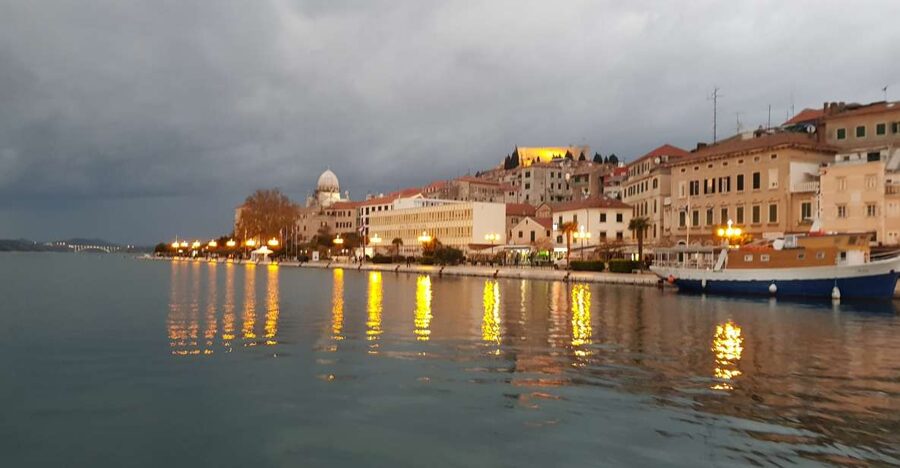
- Evening perspective: You see Šibenik’s historic center in a quieter, more atmospheric mood.
- Local storytelling: Your guide ties places to people and events, not just dates and names.
- Church details that only show up on a careful walk: From St. Francis to St. Barbara, you learn what makes each one distinct.
- Šibenik Cathedral facts you can’t spot on your own: Including the stone construction and the row of 71 sculptural portraits.
- Hidden squares and narrow lanes: The small urban spaces become the “wow” moments at night.
Why Šibenik feels different after dark
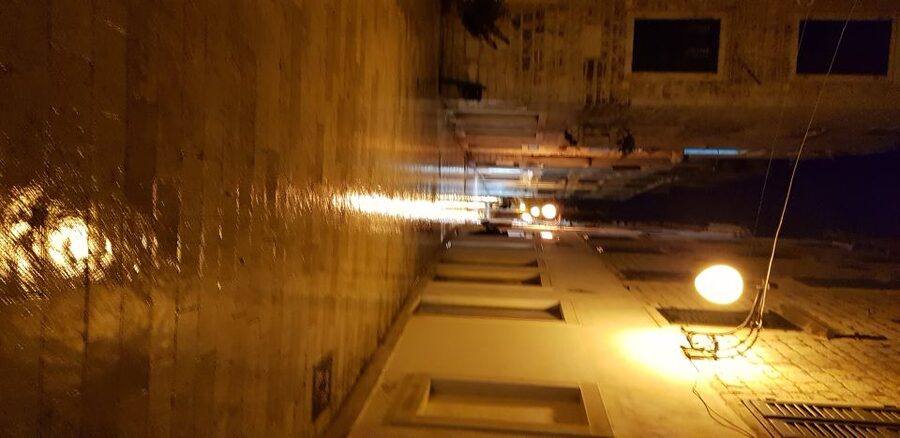
Šibenik is a Gothic-Renaissance city on Croatia’s Adriatic side, and the evening changes the whole temperature of the experience. At night, the narrow streets feel more intimate. The light on pale stone and the slower pace make it easier to notice small things, like where sightlines open into squares and courtyards.
I also like that this tour is built for understanding, not just sightseeing. The guide’s job is to help you read the city like a map of stories, so you leave knowing why certain buildings matter. You get the sense that parts of the old town take you back to the 15th or 16th century, without needing special effects.
The tone is part history lesson, part walking route. If you enjoy architectural details and street-level context, this format works well because you are moving while the explanation lands. And if you mostly want photos, you still get plenty, but the real win is the “wait, why is that here?” feeling that the guide sparks.
More Walking Tours in Sibenik
- Private Sibenik Walking Historical Morning or Evening Tour
★ 5.0 · 93 reviews - Šibenik: Medieval Night Walking Tour
★ 5.0 · 27 reviews - From Sibenik: Private Walking Sibenik Sightseeing Tour
★ 4.9 · 15 reviews
Starting at gat Krka, then slipping into the old lanes
Your tour begins at a simple landmark: the lantern at the gat Krka parking lot. Your guide wears an orange cap, which makes it easier to find the group quickly. This matters because the whole experience is time-sensitive, and evening tours can get messy if everyone arrives late.
Once you start walking, the route is designed to keep you in the historic city center. Expect cobblestones, narrow streets, and repeated little turns. That is not a problem, but it does mean comfortable shoes are not optional.
The best way to think about this tour is like getting a guided “orientation tour” for a city you might not fully understand on your own. Night helps too. The usual tourist rhythm slows down, and the guide leads you to squares and corners you would likely skip in a quick daytime loop.
You also get the benefit of learning city layout clues while you are still close enough to connect them. The guide points out key urban quirks, like why a major city square sits in an unexpected place, and how that ties into how Šibenik grew and functioned.
The story of King Petar Krešimir and why the city remembers him
One of the core reasons I recommend a guided evening walk is that you get human context. Here, the guide brings in Petar Krešimir, a king important to Šibenik and its people. Instead of treating him like a name on a plaque, you learn what he represents for the city’s identity.
This kind of historical anchor helps everything else make more sense. When you later stand near major church sites, squares, and civic buildings, you are not just looking at stone. You are placing those buildings into a broader timeline of power, patronage, and community life.
It is also a nice reminder that this is not a one-building city. Šibenik’s character comes from layers, from medieval civic life to Renaissance architecture. The guide’s explanations help you feel how those layers overlap, even when you are just walking through a street that looks small from one end.
And because you are doing this at night, the city feels more cohesive. The stories link buildings together, and you do not have the daytime distraction of crowds and heat pushing your attention away from the details.
Hidden squares and Gothic-Renaissance clues you can actually spot
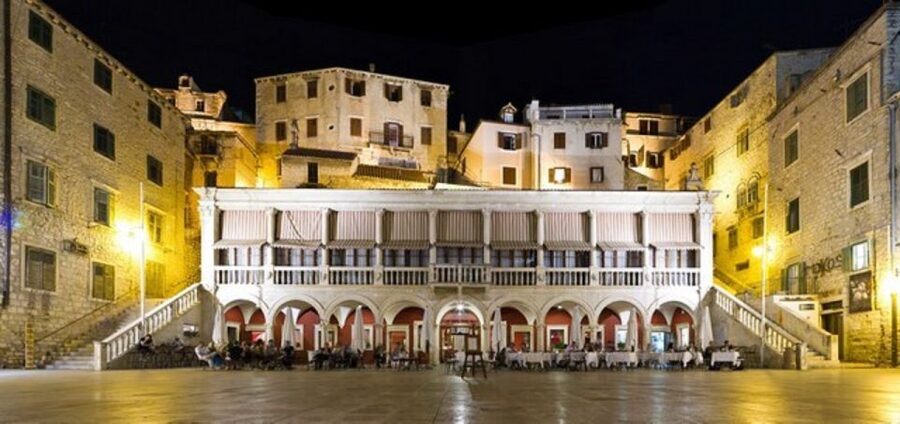
A big promise of this tour is exploring hidden squares and learning facts you would miss on your own. That is exactly the right approach for Šibenik, because the city rewards slow attention. You can walk past a doorway or small plaza and not realize it is part of the city’s bigger puzzle.
During the walk, the guide keeps pulling you toward noticeable-but-easy-to-miss cues. You might pause in a square and suddenly understand how the space functions visually, or why certain architectural elements show the style shift between eras.
The Gothic-Renaissance vibe is real here. The streets and plazas can make you feel like the city is less about modern movement and more about older rhythms. That is the advantage of walking after dark, especially if you prefer a less crowded atmosphere.
Also, the guided pace is gentle enough that you can pay attention. It is not a “race to the next photo spot.” It is the kind of walk where questions are welcome, and your guide’s job is to answer them in a way that makes you remember the details later.
Same coastline, a different sort of day:
- Krka National Park – All Sites – Entry ticket
★ 4.3 · 1,098 reviews - Vodice: Krka Waterfalls National Park Boat Tour
★ 4.6 · 250 reviews - Split: Krka National Park Full-Day Tour with Wine Tasting
★ 4.9 · 142 reviews - Kornati Experience small group (12 pax) boat tour
★ 5.0 · 89 reviews
Church stop one: St. Francis and what makes it special
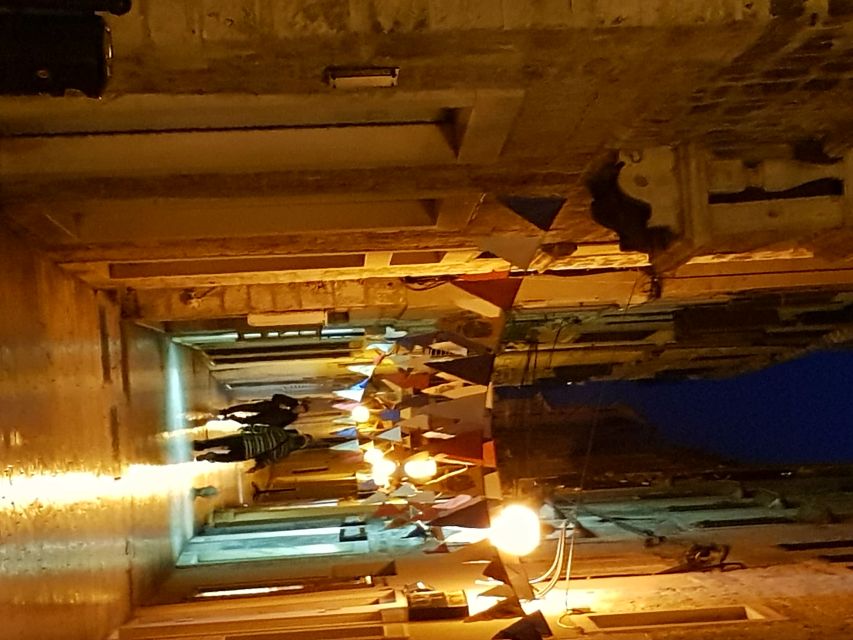
Even if churches are not your main travel focus, this tour makes them interesting. You spend time learning why St. Francis is more special than other churches in the city. The guide’s explanation helps you see it as part of a broader religious and artistic story rather than a single landmark.
When you are walking at night, church exteriors can look dramatically different than they do in daylight. That is not just lighting. You start noticing proportions and how stonework changes across sections. A good guide gives you the context for what you are seeing, so you do not just stare.
This stop is also useful if you have limited time in Šibenik. Churches can be overwhelming if you do them all alone. With a guide, you get selective attention on the “why” behind each place.
If you are someone who likes to understand how one building differs from another, this tour is the right match. You are guided to look at meaning, not just appearances.
St. John the Baptist, changing patron saints, and medieval significance
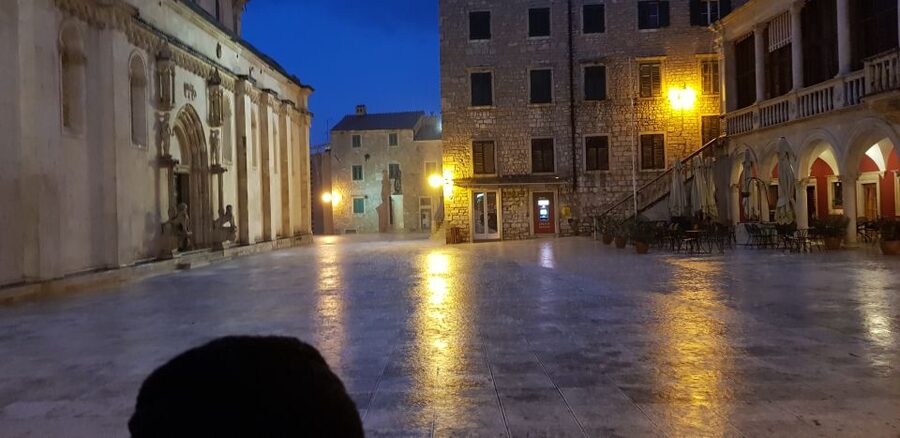
Another highlight is St. John the Baptist and the way the guide connects it to Middle Ages importance. You learn why it mattered throughout that period, and the story of how its patron saint changed.
That kind of change is a clue that cities evolve. Religious institutions, civic identity, and community priorities shift over centuries. The guide helps you see those shifts as evidence of history in action, rather than a static timeline.
At night, the emotional tone of these stories can land harder. A church becomes more than architecture. It becomes a place where communities once gathered with intense purpose. Even when you are just moving through, you feel the weight of why that site mattered.
It is a strong stop for anyone who enjoys social history, not just art history. And if you are a “repeat reader” of details, this is where your brain starts connecting symbols across different stops.
St. Krševan and the oldest church feeling
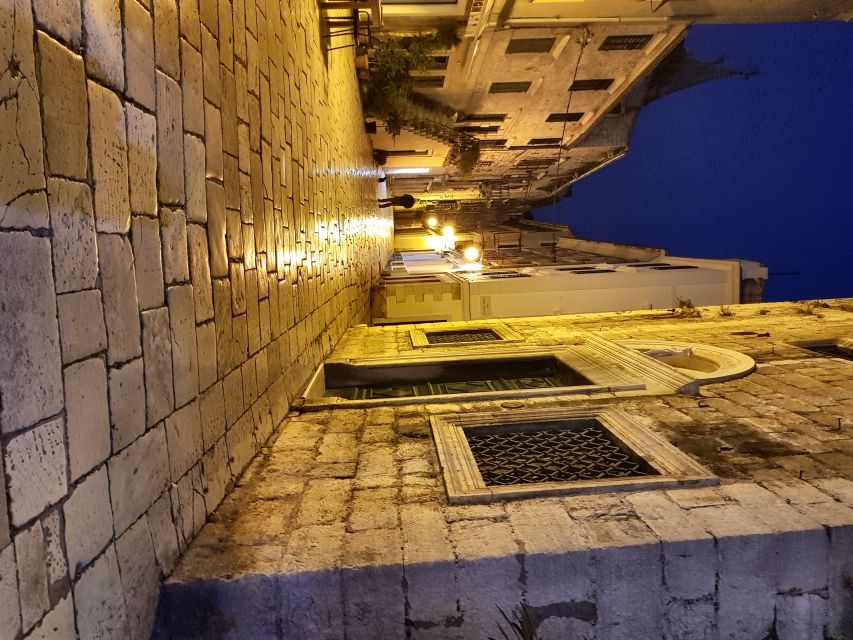
St. Krševan is another stop that is easy to appreciate because it comes with a clear claim: it is the oldest church in town. The guide uses that fact to shape how you look at the building and what it implies for Šibenik’s earliest religious footprint.
Oldest does not mean “simple.” It means “foundational.” Learning this while you are standing there gives the stop extra weight. You are not guessing which parts reflect which era. The guide guides your attention to the significance of the site’s place in time.
If you have only a couple of hours, this kind of stop helps you feel like you did more than just scratch the surface. Even one “oldest” anchor can reframe the rest of what you see after it.
Four Wells cistern: why medieval water mattered
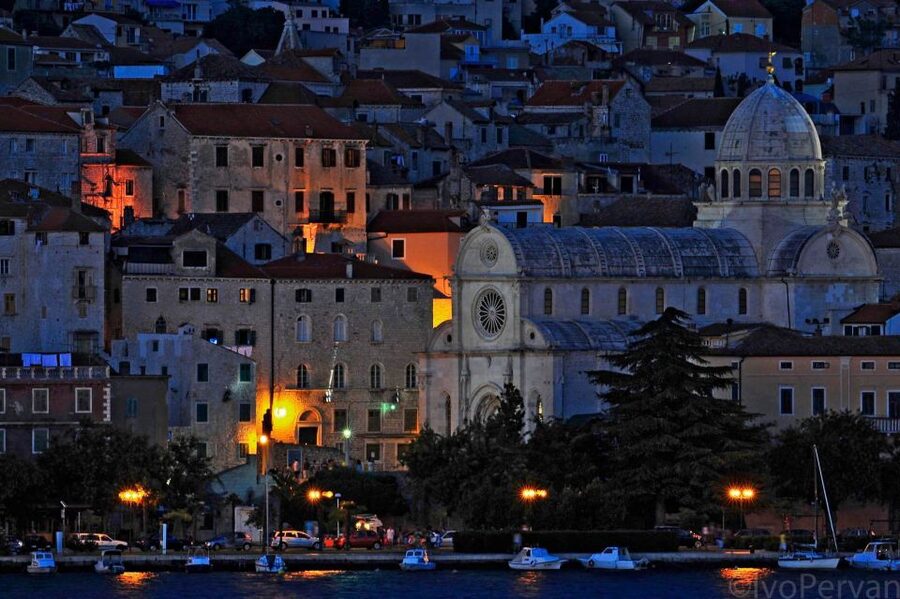
One of the most practical and surprisingly interesting stops is the public town cistern known as Four Wells. You learn why it was built during the Middle Ages. That is a key point because it reminds you the city’s history is not just about monuments.
Water infrastructure shaped where people lived, how neighborhoods functioned, and how resilient the city could be. A cistern is not glamorous in the usual travel way, but it is deeply tied to daily life. And on an evening walk, these quieter stops feel like real discovery.
If you like learning the nuts and bolts of city life, you will enjoy this part. It also helps you balance the more dramatic church and cathedral moments with something rooted in survival and routine.
This is the kind of detail you would likely not seek out alone, especially at night when you might stick to the most obvious spots.
St. Assumption of the Blessed Virgin Mary and the bell tower clues
The guide also covers the Church of the Assumption of the Blessed Virgin Mary, including who uses it and who built the interesting bell tower. There is a memory trick built into this stop, where the guide shares a way to remember the artist’s name.
That might sound like a small thing, but it is actually useful. When you can remember a name, you can later look up more about the art and feel like you have a thread to follow after the tour ends. It turns the walk into something you carry home.
This is another evening-friendly stop because bell towers and church façades often feel more dramatic under night lighting. The guide keeps you focused on what to look for, so you get the most from the moment.
St. Barbara and the bells, with a built-in sound moment
St. Barbara is one of the more memorable stops because you learn that the church has four bells, and you hear about when those bells ring. That adds a sensory layer to the tour.
Even if you cannot predict the exact moment each bell rings from your location, knowing there are four bells changes how you see the building. You might start mentally mapping what sounds would accompany the site in historic time.
This is also a good stop for mixed groups, including people who are less interested in architectural analysis. Bells are universal, and the guide’s explanation gives it meaning, not just sound.
Šibenik Cathedral: St. Jacob’s with stone slabs, ribs, and 71 portraits
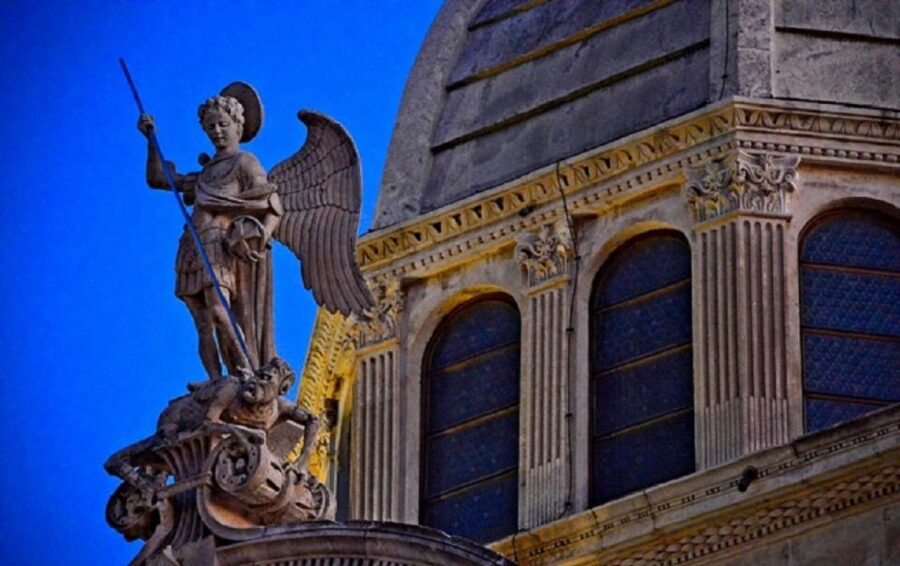
The star stop is St. Jacob’s Cathedral, and the guide gives you reasons it is unique not only in Croatian architecture, but in European architecture too. You learn that it is entirely built of stone, with a brave structure of stone slabs and ribs, and no binding material.
You also hear why it has a trefoil front façade, and why the overall architecture feels harmonious. Then comes one of the most specific facts on the route: around the apses, there are 71 realistic sculptural portraits.
This is where the evening walk earns its keep. Cathedral stops can feel like a quick glance when you do them alone. Here, you get the “read” skills needed to appreciate what you are seeing. By the time you reach it, you are already primed to look at construction technique, façade design, and the sculptural program as one connected idea.
And the night setting helps. Stonework and sculpture look different after dark, and you are calmer, so you can actually take in the details instead of rushing.
The National Theatre and the electric lighting fact from 1896
The tour also includes the Croatian National Theater in Šibenik. You learn that it once was the largest and most beautiful theater in South Europe. The detail that sticks is the electric lighting in 1896, described as one of the first theater light setups in the world.
Even if you are not a theater person, this is a useful “city ambition” clue. It shows Šibenik invested in culture and modern tech during the period when many cities were still figuring out electrification.
Night works well for this stop because theater buildings often feel more symbolic after hours. The guide gives you the why, so it is not just a photo façade.
It is also a break from church architecture rhythm. You get civic and cultural architecture, and it changes the pace of your attention.
The practical reality: $45 for 90 minutes and what that buys you
At $45 per person for 90 minutes, you are paying for one main thing: a human interpreter. That matters in places like Šibenik where the city is compact but information-rich. A good guide helps you avoid the waste of walking without understanding what you are looking at.
You also get value from the evening timing. The tour is designed to help you avoid the usual tourist crowds, and that is not a small benefit. Less crowd pressure means you can stop more often and actually hear the explanation instead of competing with noise.
What is not included is food and drinks, and there is no hotel pickup or drop-off. That is typical for walking tours, and it keeps the price in check. Plan to eat before you go, or after you finish, when you can pick a place that fits your mood.
If you like structure, this tour delivers it. If you prefer total freedom, you can still use the tour as a starter, then explore on your own afterward from the same general area.
What to bring, and the one real logistics issue
Bring comfortable shoes. The route is a walking experience through cobblestones and historic streets, which can be uneven underfoot. If you are going on a rainy evening, those stones can be slick, so traction matters.
Also, plan for a true walking pace. It is not a sit-down talk. It is a guided walk, and the time is built around stopping at key spots.
Language options are practical too. You can choose English, German, or Croatian with a live guide. That makes the stories accessible without needing to “figure it out” on your own.
If you have mobility impairments, this tour is not suitable based on the activity details. That is worth taking seriously, since evening cobblestones do not forgive.
Who this evening walk suits best
This is a great match if you want to learn quickly and see more than the obvious storefront highlights. It is especially good if you enjoy religious architecture, civic history, and the kind of city facts that make you feel smarter while you are walking.
It is also ideal for couples and small groups who want shared conversation. The guide’s humor and personality, like what you might experience with guides such as Irena and Mariana, can make the pace feel light while the information stays substantial.
If you love silent self-guided wandering with zero structure, you might find a tour format limiting. But even then, doing this as an opener can give you a mental map so your later independent walks feel more intentional.
If you are short on time in Šibenik, a 90-minute route is a practical investment. You get multiple major stops in one evening without spending your whole day trying to piece it together.
Should you book this Šibenik evening walking tour?
Book it if you want the best return on your limited time, and you like architecture with context. The price is reasonable for a guided experience that covers big landmarks like St. Jacob’s Cathedral and the National Theatre, plus smaller story-rich stops like Four Wells.
Skip it only if you know you cannot handle uneven cobblestones or longer standing and walking. Also skip it if you dislike guided talking. This tour works because you are there to listen, pause, and look.
If you do book, wear shoes you can trust, arrive a few minutes early at gat Krka, and plan to explore cafes and restaurants afterward at your own pace. By the end, the city usually feels less like a stop on a map and more like a place with a past you can actually name.
FAQ
What’s the duration of the guided evening walking tour in Šibenik?
The tour runs for 90 minutes.
How much does the tour cost?
It costs $45 per person.
Where do I meet the guide?
Meet next to the lantern at the gat Krka parking lot. The guide will be wearing an orange cap, and you should arrive at least 5 minutes early.
Which languages are available for the live guide?
The live tour guide is available in English, German, and Croatian.
Is pickup from my hotel included?
No. Hotel pickup and drop-off are not included.
Are food and drinks included?
No. Food and drinks are not included.
What should I bring?
Wear comfortable shoes.
Is the tour suitable for people with mobility impairments?
No, the tour is not suitable for people with mobility impairments.
Newest Sibenik reviews on the site
- The beauty of the Middle Ages-Šibenik★ 4.7 · 7 reviews
- Šibenik: Sea Kayaking Tour to St. Nicholas Fortress★ 4.8 · 28 reviews
- Šibenik walking tour in one hour!★ 5.0 · 6 reviews
- Šibenik: 3 Fortresses and Panorama Tour★ 4.8 · 55 reviews
- Šibenik : Zipline Šibenik – Čikola Canyon★ 5.0 · 3 reviews
- Šibenik: Archipelago Boat Tour with Snorkeling & Wine★ 4.5 · 9 reviews
- Sibenik: Full-Day Kornati National Park Boat Tour★ 5.0 · 19 reviews
- Šibenik: 3 hours City&wine tour, tasting and fortresses inc★ 4.8 · 12 reviews
Walking Tours, compared.
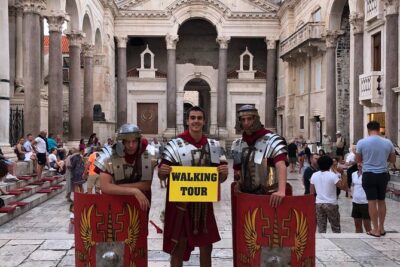
Walking Tour of Split and Diocletian’s Palace
Read our review →
Krka Waterfalls tour with Trogir Walking tour and Krka panoramic boat cruise
Read our review →
City Walls Early Morning or Sunset Walking Tour
Read our review →Browse the lists this tour appears in