
Review · MUSEUMS
SPLIT-PREMIUM Emperor’s Walking Tour for History Lovers + Museum
Split history hits different when you walk. This 2-hour Emperor’s walking tour focuses on Diocletian’s Palace and the medieval streets around it, with a licensed local guide. You move through real spaces people still use today, from palace gates to lively squares, then wrap with a quick look at Split’s old-time clock and Roman temple reminders.
I especially like the small-group feel. With a maximum of 15 people (and often fewer), your guide can slow down for questions and still keep the pace moving. I also like the strong emphasis on local, everyday history, not just dates, which is why guides like Joško, Daniela, and Joseph come through in a way that feels personal and practical.
One thing to consider: this is a serious history walk. If you want Game of Thrones explanations, you will still spot some filming locations, but you’ll need to recognize them yourself or do a bit of prep.
In This Review
- Key highlights worth planning for
- Starting at Riva, then stepping into 305 AD
- Palazzo di Diocleziano and Diocletian’s Palace, the city’s foundation
- Old Split and Saint Domnius: medieval streets, Roman muscle memory
- Riva-to-Peristyle flow: Emperor’s Square brings the palace to life
- People’s Square, then you shift from medieval to Roman again
- The City Clock and Golden Gate: where you spot continuity
- Diocletian’s Palace substructures and the Vestibulum entrance
- The optional Diocletian Cellars museum: when extra money makes sense
- Price, group size, and what you get for $30
- Who this tour fits best, and who should skip it
- Timing your walk in Split: heat, photos, and pacing
- Should you book? My honest recommendation for Split history lovers
- FAQ
- How long is the Split Emperor’s Walking Tour?
- How much does the tour cost?
- What language is the tour offered in?
- Is admission included for the Diocletian Cellars museum?
- Is the tour only for adults?
- How many people are in the group?
- What happens if the tour does not meet the minimum number of guests?
- Where does the tour start and end?
- What if the weather is poor?
Key highlights worth planning for
- Diocletian’s Palace, UNESCO scale in just 2 hours: you get the layout and the meaning, not just photo stops
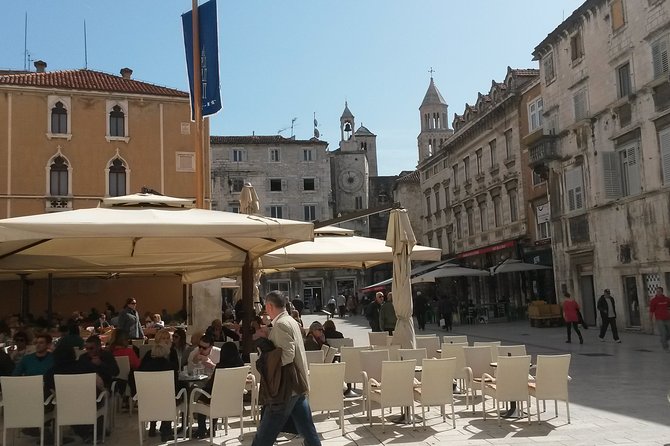
- Emperor’s Square (Peristyle) + Old Split squares: the walk centers on where power and everyday life meet
- Roman and Croatian history in the same route: from Jupiter-style temple ruins to statues tied to Croatian literature and identity
- Outside views when it matters: Cathedral of Saint Domnius and other landmarks are framed from the street for context
- Optional extras you can choose: Temple of Jupiter inside is optional, and the Diocletian Cellars museum is extra (€10)
Starting at Riva, then stepping into 305 AD
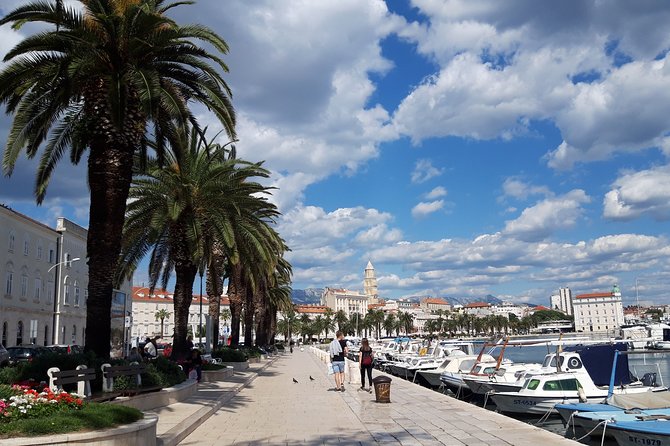
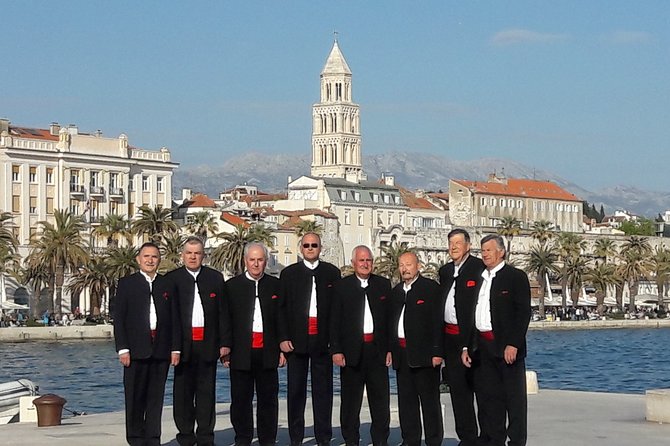
Split’s waterfront, the Riva promenade, is where a lot of visitors get their bearings. This tour starts and finishes at the Main Stage on the waterfront, so you’re not stuck searching for an obscure side street. It also means the vibe shifts fast: you go from sea-breeze relaxation to a dense pocket of stone, arches, and Roman planning.
What makes that good for you is momentum. You’re walking into a story that runs through the whole city. Diocletian’s retirement palace, built in 305 AD, wasn’t a one-time monument. It became a shell that later generations filled with medieval life, churches, markets, and public squares.
You’ll get the walk in about 2 hours, but it won’t feel like a rushed checklist. The tour is designed as a sequence, with each stop adding context for the next one. Many groups also keep moving even when time is tight, and the guides are known for staying flexible when someone needs the pace adjusted.
More History Tours in Split
- Walking Tour of Split with a ‘Magister’ of History
★ 5.0 · 1,122 reviews - Split Walking Tour with Professor of History
★ 5.0 · 926 reviews - Split: History and Heritage Walking Tour
★ 4.9 · 650 reviews
Palazzo di Diocleziano and Diocletian’s Palace, the city’s foundation
The first stop is Palazzo di Diocleziano, your gateway into Diocletian’s Palace, a UNESCO World Heritage Site. Even when the official “tour of the palace” piece feels brief, the guide’s job is to make the palace layout click in your head.
Here’s what you’re really learning: the palace is not only Roman stone. It was a complete system, built as an emperor’s world with gates, courtyards, and corridors. Then, after the empire’s grip shifted, that infrastructure became the skeleton for later Split.
This stop works best if you show up with a basic curiosity. If you think Roman history equals columns and quiet museums, you’ll be surprised by how the palace courtyard space turns into daily street-life.
Quick drawback: the palace is big. In two hours you won’t see everything in full detail. The payoff is that you’ll know what to prioritize next, if you want to return on your own.
Old Split and Saint Domnius: medieval streets, Roman muscle memory
Next comes Old Split, the medieval town that grew around (and inside) the palace structure. Your guide will use the street pattern to connect earlier Roman geometry with later street life. This is where Split stops feeling like a ruin and starts feeling like a living city.
Then you get a brief look at the Cathedral of Saint Domnius from outside. That matters because it shows you how later faith landmarks sit right on top of, or right next to, earlier eras. You’re not just seeing architecture. You’re seeing reuse, which is one of the biggest themes in Split.
If you love history that explains why places look the way they do today, these two stops deliver. They also help you understand why locals keep treating the palace as the heart of the city rather than as a fenced-off attraction.
Practical tip: Old Split can be a maze. This tour helps you avoid that first-day confusion.
Riva-to-Peristyle flow: Emperor’s Square brings the palace to life
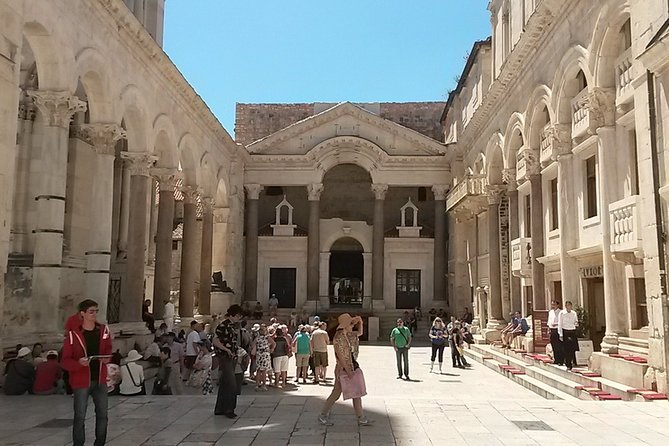
One of the best sections is the visit to the Peristyle, also called Emperor’s Square, the heart and soul of the palace town. This is the moment where the whole palace concept becomes visible at human scale.
Think of it like this: the palace gates and substructures are impressive, but the Peristyle is where you can picture power made public. It’s an open, central space, so your guide can explain how people moved through it and why it mattered.
After Peristyle, the route keeps you moving through nearby historical anchors:
- You’ll stop at Grgur Ninski statue, tied to one of Croatia’s important historical figures. The guide explains why that person still matters.
- Then you’ll reach Fruit’s Square (Trg Brace Radic), where you’ll find a statue of Marul, often described as the father of Croatian literature. This is the kind of detail that turns a walk into a learning experience.
These stops are short, around 5 minutes each, but they land because they connect history to names you’ll keep seeing across Split. It’s not random statuary. It’s identity.
More Museum Tours in Split
- Blue Lagoon & Underwater Museum from Split with Lunch & Drinks
★ 4.5 · 1,122 reviews - Split: Klis Fortress GOT and Olive Museum Entry Tickets
★ 4.6 · 283 reviews - Split: Green Line with Open Bus to Klis & Olive Museum
★ 4.2 · 142 reviews - Split: Olive museum Klis with Olive Oil Tasting
★ 4.9 · 51 reviews
People’s Square, then you shift from medieval to Roman again
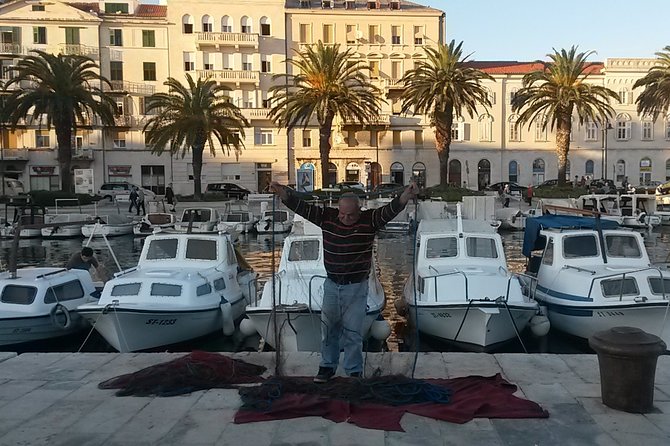
Narodni Trg, People’s Square, is next. It’s the biggest and liveliest piazza in Old Town, so even if your mind is in Roman mode, your body registers this as the social center. This stop gives you contrast: inside palace walls, it’s about structure and authority. In squares, it’s about gathering.
After that, you move back toward Roman themes with the Temple of Jupiter. You’ll see it from outside, and inside is optional. That optional inside moment is worth considering if you like depth over speed, because it can take a bit more time than the exterior view alone.
Here’s the key value for your planning: the guide helps you understand which parts are functional reminders of Roman worship, and which parts are later interpretations or preserved fragments. You’ll get a sense of what’s “original” versus what’s “survived” versus what’s “transformed.”
Possible drawback: the optional inside visit can tempt you into choosing less of another stop if you’re tight on time. If you’re the kind of person who wants everything, pace yourself.
The City Clock and Golden Gate: where you spot continuity

One of the quickest but coolest moments is the City Clock, a 24-hour clock that’s around 500 years old. Even in short outdoor looks, your guide can explain why a city like Split kept time in public ways, and what that reveals about daily life.
Then you get the Golden Gate, the main and most beautiful entrance into Diocletian’s Palace. This is a “yes, that’s the place” stop. Once you see the gate, the palace stops being an abstract idea. You understand the arrival point, the sense of threshold, and how movement into the palace is meant to feel.
If you’re into photography, this is one of the moments where you’ll be glad you’re not alone. A small group keeps you from constantly waiting, but it still gives you enough space to frame shots without turning the whole tour into a traffic jam.
Diocletian’s Palace substructures and the Vestibulum entrance
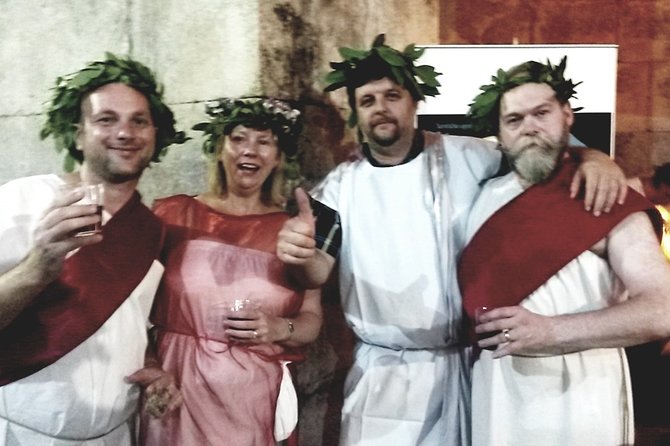
After the Roman-Christian-medieval rhythm of gates, squares, and statues, you end with the palace’s most preserved pieces: the Diocletian Palace substructures. This is where the palace’s engineering shows through. It’s also a reminder that the “visible” palace above ground relies on what’s underneath.
You’ll then visit the Vestibulum of Diocletian’s Palace, the main entrance to the private residence of the emperor. Even if your stop is short, your guide ties it back to the big theme of the walk: this city was built with authority built into space. The private areas weren’t just rooms. They were part of a design system.
At the end of this section, you should feel like you can orient yourself in Old Town. That’s the real win of this kind of tour. It’s not only what you see. It’s what you can make sense of later.
The optional Diocletian Cellars museum: when extra money makes sense
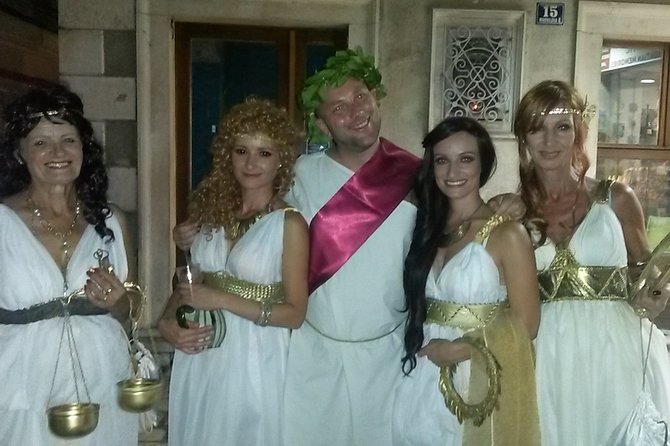
The tour does not include admission to the Museum of Diocletian’s Cellars, which is listed as €10 per person. If you’re the kind of traveler who likes to go from “I understood the layout” to “I want to see more physical evidence,” this is a smart add-on.
But if you’re already museum’d out after a few days in Croatia, you can skip it and use your time elsewhere. The core tour already gives you the palace framework you need.
A good way to decide: if you’re excited by preserved parts and underground or substructure context, the cellars museum is likely worth the extra fee. If you mainly want street-level history and Roman city planning, focus on the walking route and save your energy.
Price, group size, and what you get for $30
At $30 per person for about 2 hours, this tour is priced like a “high value intro” rather than a long-haul deep specialization. And honestly, for Split, that’s the sweet spot.
Why it’s good value:
- You get a licensed resident guide instead of just a generic audio walk
- You cover the core palace story plus Old Split anchors in a single route
- The group is adult-only for the group tour, which often helps keep the tone focused and easy to follow
Group size details matter. The tour is capped at a maximum of 15 travelers, and it runs with a minimum number of guests (minimum is 4). Smaller groups also help your guide manage timing and answer questions without turning it into a sprint.
When I compare it with bigger walking tours in old European cities, this one has the right tradeoff: you don’t pay for endless stops, you pay for better connection between stops.
Who this tour fits best, and who should skip it
This tour is ideal for history lovers who want a grounded introduction to Split, especially Diocletian’s Palace. It’s also a good match for people who like guides who use humor to keep dense topics moving. Joško and Daniela are names that come up with the strongest impression, often described as funny, engaging, and able to explain history in a way that sticks.
It’s also a solid choice if you’re a little short on time. Because the route hits the palace spine, gates, squares, and Roman reminders, you leave with a mental map. You can then wander on your own with more confidence.
Skip it if you’re looking for:
- A TV-themed Game of Thrones storytelling tour. You might spot filming locations, but this is built as history.
- A full museum day. The palace walk is focused, and the cellars museum has an extra fee.
Timing your walk in Split: heat, photos, and pacing
Split can get hot fast, and walking tours can feel longer when the sun is doing its job. Plan for good weather, because the experience requires it. If conditions are poor and the tour is canceled, you’ll usually have the option to choose a different date or get a refund.
For your best experience, aim to do this earlier in the day when possible. You’ll enjoy the palace surfaces more, and you’ll have less trouble keeping energy up for all the short but frequent orientation moments.
Bring the basics: water, sun protection, and comfortable shoes. The route is a walking tour through uneven old town streets, so shoes matter more than you think.
Should you book? My honest recommendation for Split history lovers
I think you should book this tour if you want the fastest path to understanding why Split looks the way it does. You’ll get Diocletian’s Palace framework, the key palace heart at the Peristyle, and the Old Split squares and statue stories that explain Croatian cultural identity. For $30, it’s a strong entry ticket into the city.
I’d only hesitate if you’re not a history person or you specifically want a TV production guide. This walk is about real structures, real names, and real centuries layered together. If that’s your kind of trip, you’re in the right place.
FAQ
How long is the Split Emperor’s Walking Tour?
The tour lasts about 2 hours.
How much does the tour cost?
The price is $30.00 per person.
What language is the tour offered in?
The tour is offered in English.
Is admission included for the Diocletian Cellars museum?
No. Admission to the Museum of Diocletian’s Cellars is not included and costs €10.00 per person.
Is the tour only for adults?
Yes, the group tour is adults only. A private tour is for all ages.
How many people are in the group?
It is a small-group tour with a maximum of 15 travelers.
What happens if the tour does not meet the minimum number of guests?
The minimum number of guests to run the group tour is 4. If it is canceled because the minimum isn’t met, you’ll be offered a different date or a different experience, or you’ll get a full refund.
Where does the tour start and end?
The tour starts and finishes back at the Main Stage on the Riva promenade waterfront. The meeting point listed is Obala Hrvatskog narodnog preporoda 22, 21000, Split.
What if the weather is poor?
The experience requires good weather. If it’s canceled due to poor weather, you’ll be offered a different date or a full refund.
More Museums in Split
- From Split: Blue Lagoon & Underwater Museum (Lunch & drinks)
★ 4.8 · 39 reviews - Split: All Inclusive,Underwater Museum,Trogir, Blue Lagoon
★ 4.7 · 28 reviews - Zagreb: Skip-the-Ticket-Line Museum of Broken Relationships
★ 4.5 · 847 reviews - Zagreb: Nikola Tesla Technical Museum Ticket
★ 4.5 · 520 reviews
More Walking Tours in Split
- Split: Old Town and Diocletian Palace Walking Tour
★ 4.9 · 4,727 reviews - Walking Tour of Split and Diocletian’s Palace
★ 5.0 · 2,588 reviews - Krka Waterfalls tour with Trogir Walking tour and Krka panoramic boat cruise
★ 5.0 · 1,659 reviews - Split & Diocletian’s Palace Walking Tour
★ 5.0 · 1,125 reviews
Newest Split reviews on the site
- Split: Blue Lagoon Boat Trip with Lunch, Wine and Snorkeling★ 5.0 · 3 reviews
- Split: Guided Sunset Sea Kayaking & Snorkeling Tour★ 4.8 · 185 reviews
- Split: Sunset Guided Kayaking Tour★ 4.8 · 71 reviews
- Sunset Cruise With Music and Views of Split Riviera★ 3.6 · 10 reviews
- Step into History: Private Guided Walking Tour of Split★ 5.0 · 3 reviews
- Stand Up Paddle Tour in Split★ 4.7 · 17 reviews
- Split&Sip: Educational wine tasting★ 4.9 · 52 reviews
- Split Walking Tour with History Professor★ 5.0 · 23 reviews
Museums, compared.

Blue Lagoon & Underwater Museum from Split with Lunch & Drinks
Read our review →
Skip-the-Ticket-Line Museum of Broken Relationships
Read our review →


Blue Lagoon Underwater Museum Tour w/Lunch & Drinks
Read our review →
Klis Fortress GOT and Olive Museum Entry Tickets
Read our review →

Browse the lists this tour appears in