
Review · HISTORICAL TOURS
Split Walking Tour with Professor of History
A visit to Split gets way better when someone explains what you are seeing. This professor of history style tour walks the historic center with smart context for the streets and stones, not just dates, and it keeps things entertaining with guides who can make big ideas click. I especially like the small group feel and the way the walk threads everyday Split life together with Roman-era power.
The biggest drawback to plan for is time. The tour runs about 2 hours 20 minutes on the schedule, but at least one group report suggests it can run closer to 3 hours when the guide adds extra stories and stops for questions.
In This Review
- Key Things You Should Know Before You Go
- What a History Professor Tour Changes in Split
- Price and Value: Why $24.19 Works Here
- Getting Oriented at Brass Gate (Porta Aenea)
- Riva Promenade: Start with the Public Life
- Diocletian’s Palace Substructures: The World-Class Basement Halls
- Peristyle and Vestibule: Where the Emperor Experience Happened
- Saint Domnius Outside: A Temple, Mausoleum, and Church at Once
- Temple of Jupiter Outside and the Let Me Pass Street
- Golden Gate: The Emperor’s Main Entrance, Now Repaired
- Grgur Ninski Statue, Marmontova Ulica, and the Shortcut Through Culture
- Prokurative and Fruit’s Square: Where Stories Turn to Life and Food
- How Long Should You Plan For?
- Who This Tour Fits Best
- Should You Book This Split Walking Tour?
- FAQ
- How long is the Split walking tour?
- Where does the tour start and end?
- Is the tour offered in English?
- How big is the group?
- Do I need to buy tickets for the sights?
- What is included in the price?
- Is alcohol included?
- Does the tour require good weather?
- What is the cancellation policy?
Key Things You Should Know Before You Go

- Professor-led storytelling: You get historical context tied directly to the places you pass.
- Small group size (max 17): Easier questions, more personal attention, and less waiting.
- Diocletian’s Palace focus: Substructures, Peristyle, Vestibule, and the gates you can actually locate on foot.
- Outside views for some sights: Saint Domnius and the Temple of Jupiter are covered from outside, with optional entry after the tour.
- Low-stress sightseeing route: Most stops are quick and you keep moving through the old town.
- Upgrade option: You can switch to a private tour if you want a more tailored pacing.
What a History Professor Tour Changes in Split
Split can feel like two cities at once: lived-in seaside life and an ancient Roman shell that still shapes the town. The best tours do not treat those as separate things. This one connects them, so you understand why the streets curve where they do, why certain buildings matter, and how the place kept evolving.
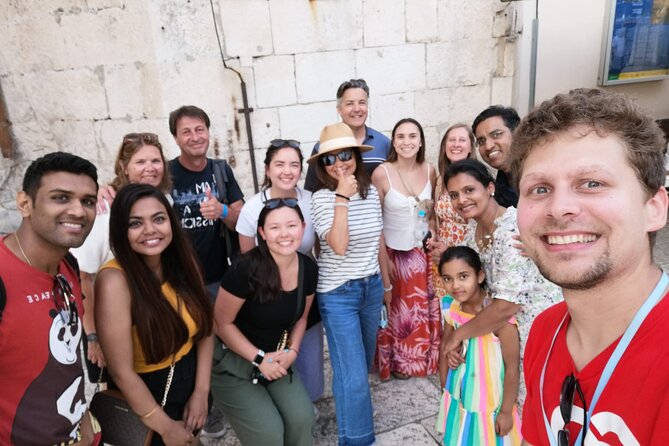
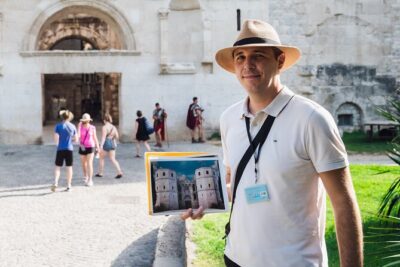
I also like that the guides are described as educators first, not just reciters. Guides named Mario and Anita get credited for mixing scholarship with humor, including trivia and jokes that keep the group paying attention. If you enjoy a little myth-busting, this is exactly the kind of tone that works.
Finally, you get a chance to ask questions in a small group. When a guide is comfortable with back-and-forth, the walk stops feeling like a lecture and starts feeling like a guided conversation through old streets.
More History Tours in Split
- Walking Tour of Split with a ‘Magister’ of History
★ 5.0 · 1,122 reviews - Split: History and Heritage Walking Tour
★ 4.9 · 650 reviews - Split History and Gastro Small-Group Tour with Food and Drinks
★ 5.0 · 375 reviews
Price and Value: Why $24.19 Works Here
At about $24.19 per person for roughly 2 hours 20 minutes, you are paying for two things that usually cost extra elsewhere: expert interpretation and time saved from self-sorting the layout. In a place like Split, it is not the monuments that are hard, it is understanding how they fit together.
Most of the walking route includes stops with free admission tickets, which helps keep the experience predictable. You still see the big hitters, and the optional inside visits are clearly separated. That is good value, because you can choose how deep you want to go without being forced into additional costs mid-walk.
Also, the tour is in English, and guides are described as providing clear English and organizing the group well. When the explanation is strong, you get more out of the same photos you would take on your own.
Getting Oriented at Brass Gate (Porta Aenea)
The walk starts at the Brass Gate, also known as Porta Aenea, and the tour ends back at the same meeting point. That matters because it makes the route feel finishable, not like an open-ended trek through the city.
Before you start, take a minute to settle your bearings. Split’s old center is walkable, but it is easy to wander into the wrong lane if you have not anchored yourself to the palace perimeter. Starting at the palace gates is a smart way to lock in your mental map early.
If you are arriving by foot from the waterfront, you will likely recognize the vibe right away. You start near the public promenade area, so you can switch into sightseeing mode without needing transportation planning.
Riva Promenade: Start with the Public Life
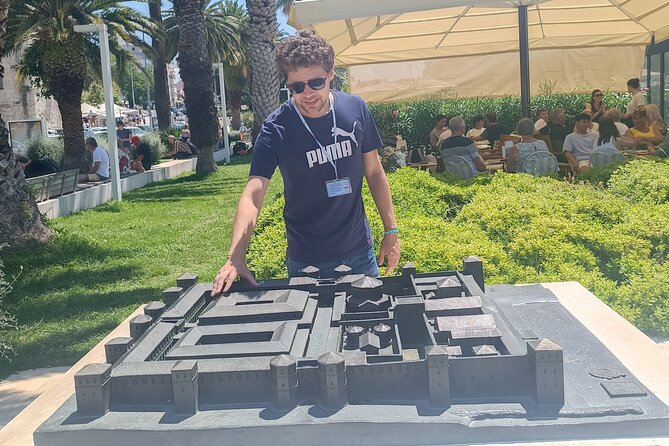
Stop one is Riva Harbor on the Riva promenade, right next to a model of the Palace. This is not a random starting point. It is where daily Split hangs out, with coffee culture, sun time, and the kind of public energy that makes the rest of the tour easier to picture.
You get about 15 minutes here, and it works as a warm-up. Instead of rushing straight into ruins, you learn what the waterfront feels like now, and then you contrast that with how the area functioned when Roman power shaped the city.
Practical tip: if you are sensitive to sun or heat, this is also when you can gauge where shaded pauses might be available later. Several guides are described as keeping the group comfortable, including attention to shade during explanations.
More Walking Tours in Split
- Split: Old Town and Diocletian Palace Walking Tour
★ 4.9 · 4,727 reviews - Walking Tour of Split and Diocletian’s Palace
★ 5.0 · 2,588 reviews - Krka Waterfalls tour with Trogir Walking tour and Krka panoramic boat cruise
★ 5.0 · 1,659 reviews - Split & Diocletian’s Palace Walking Tour
★ 5.0 · 1,125 reviews
Diocletian’s Palace Substructures: The World-Class Basement Halls
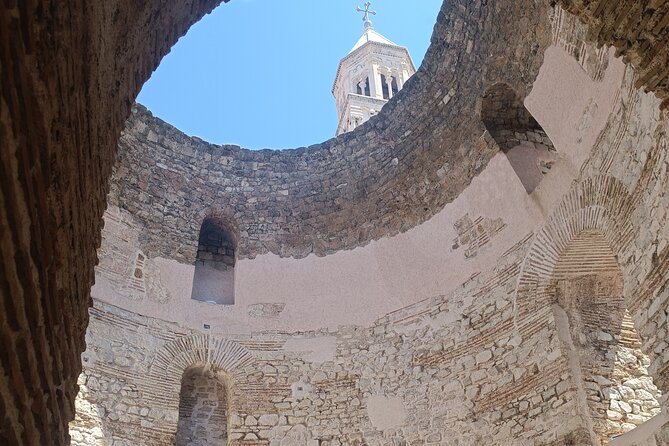
Next comes one of the tour’s core draws: the Diocletian Palace substructures, the basement halls that remain among the best-preserved complexes from classical antiquity. This is a big deal for Split’s identity, and it is one reason the historic center was added to UNESCO’s World Heritage List in 1979.
The tour gives you about 15 minutes here, and the value is in interpretation. These spaces are not just “cool old rooms.” With a professor-led explanation, you start to understand function and scale, and you see how the palace sat above life that was practical, sheltered, and connected to the palace’s higher level.
Potential drawback: if you are the kind of visitor who wants long museum-style time, 15 minutes may feel short. But the upside is you are not stuck in one spot. You keep building the bigger picture of the palace through multiple linked stops.
Peristyle and Vestibule: Where the Emperor Experience Happened
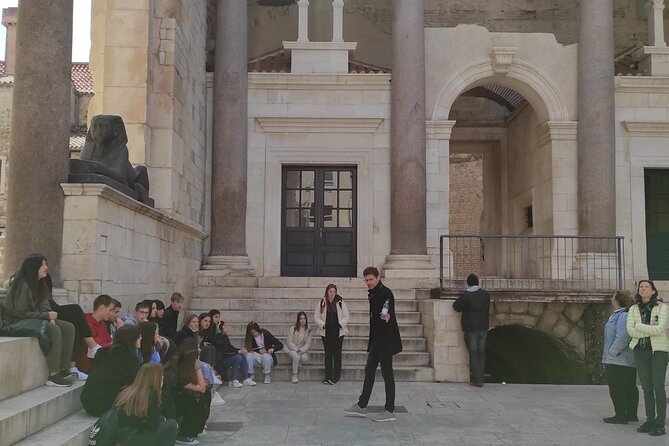
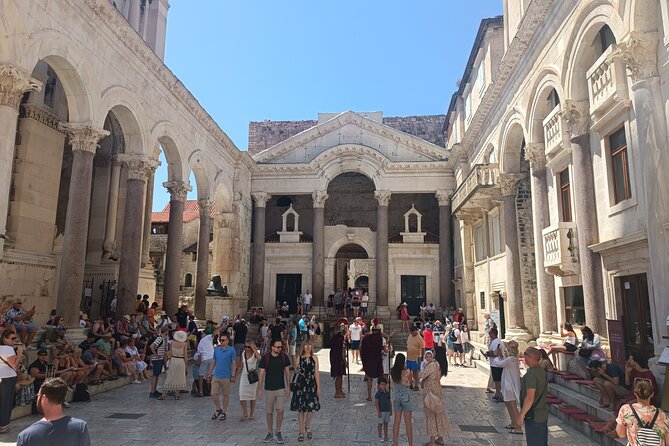
The Peristyle is the central square of Diocletian’s Palace, presented here as a ceremonial hub. The tour describes how the emperor was imagined as a living son of Jupiter, and how people approached in ways meant to dramatize authority. Even if you do not memorize every detail, this framing helps you “read” the space.
Right after that, you get the Vestibul, sometimes described as the Rotonda, part of the imperial corridor leading from the Peristyle. You are told it was built up to the beginning of the 4th century and that it is a circular hall with a height around 17 meters and a diameter around 12 meters. The story includes that this was a formal meeting space for selected audiences like ambassadors.
These are about 10 minutes each, and the magic is how quickly you understand palace choreography. You are not just looking at stones. You are learning a sequence of movement and attention, like stage blocking that still influences how the town flows today.
Saint Domnius Outside: A Temple, Mausoleum, and Church at Once
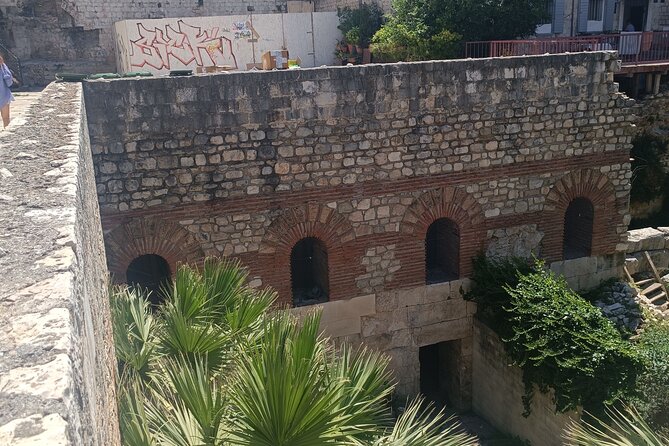
The Cathedral of Saint Domnius is treated differently on purpose. You visit it from the outside only, since entrance is not included. You still get around 20 minutes, with detailed explanations delivered during the walk-by.
Why this works: from outside, you can track the story of the structure changing roles over time. The tour presentation frames it as a Roman temple and mausoleum that became a church, depending on how you look at it. Once you have that mental lens, even a quick exterior view becomes more meaningful.
If you want the inside experience, you will need to plan a separate entry after the tour. That flexibility is a plus, especially if you have limited time on your Split day.
Temple of Jupiter Outside and the Let Me Pass Street
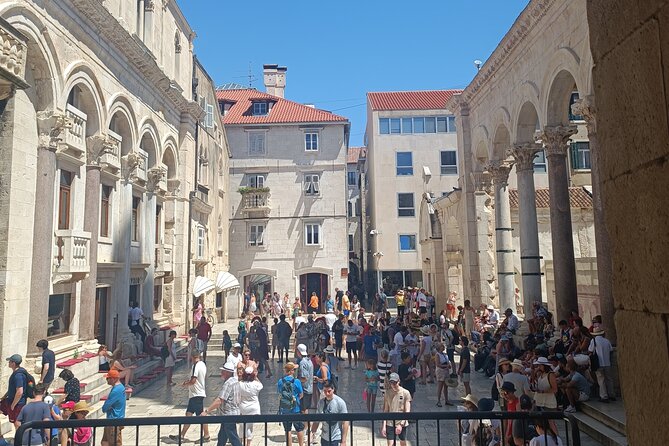
The Temple of Jupiter is another outside-only stop, with admission not included. You learn that Jupiter was the sky and thunder god and supreme figure in Roman religion. The tour also notes a later conversion into a baptistery dedicated to St. John the Baptist, which again reinforces how the site kept getting re-used.
On the way to the Golden Gate, you walk through a narrow street locals believe is among the narrowest in the world. The name given is Let me pass street. It is a small moment, but it is the kind of street-level detail that makes a walking tour feel lived-in rather than textbook-only.
Practical tip: this is a good time to take photos, but keep your pace. Narrow lanes can bottleneck if people stop suddenly.
Golden Gate: The Emperor’s Main Entrance, Now Repaired
The Golden Gate, also called the Northern Gate, is one of the main Roman gates into the old town of Split. The tour explains it was built as part of Diocletian’s Palace, serving as the main gate for the emperor, and that it was decorated to mark status.
You learn how it was sealed off over the Middle Ages and lost columns and statuary, then later reopened and repaired in modern times. It is about 15 minutes, and it is worth it because you start connecting the “where” of palace power to the “what” you see today in the streetscape.
Grgur Ninski Statue, Marmontova Ulica, and the Shortcut Through Culture
You then hit a trio of quick, enjoyable points that break up the heavier palace material.
First is the Grgur Ninski Statue, a tall Gregory of Nin by Ivan Meštrović. The tour highlights that people rub the statue’s toe for good luck, and the toe has worn smooth from repeated touching. This is one of those crowd-friendly stops that feels playful while still tied to local tradition.
Next is Marmontova Ulica, named for Napoleon’s marshal Marmont. The explanation is that even though he is remembered as a conqueror, Split’s citizens named one of their most beautiful streets after him. This helps you see how layers of history show up in everyday naming, not just grand monuments.
These stops are short, around 10 minutes each, but they work as a reset. Your brain gets a breather before the open squares and final storytelling finish.
Prokurative and Fruit’s Square: Where Stories Turn to Life and Food
Republic Square is represented by Prokurative, a large open square framed on three sides by neo-Renaissance buildings. It is about 10 minutes, but it is a big visual contrast from the tight palace streets.
Then you end at Fruit’s Square, Trg Brace Radic. This is where the tour shifts from stone to social history, with the note that women used to sell fruit there. You also hear about the Marko Marulić statue, described as the father of Croatian literature.
This final stop is also where gastronomy fits in. You are told it is a good place for stories connecting Croatian history with food culture, and guides are often remembered for offering practical suggestions around where to eat and what to look for next.
One review mentions a follow-up message with extra helpful places to eat and things to do, which is a smart bonus if you want an itinerary for after the tour, not just while you are walking.
How Long Should You Plan For?
The listing-style timing is around 2 hours 20 minutes, but at least one group report suggests it can run closer to 3 hours if the guide takes time for more stories. The difference usually comes down to pace and how many questions the group asks.
So plan like this: if you have another reservation, leave buffer time. This is not the kind of walk you want to stack back-to-back with a timed ticket elsewhere.
Who This Tour Fits Best
This walk is ideal if you want your Split day to feel structured, not random. It is also a strong match for people who care about how cities change over centuries, since you cover Roman origins, later religious conversion, and medieval and modern layers.
It is especially good for first-time visitors who want to understand Diocletian’s Palace fast, without spending hours trying to figure out what each doorway and arch used to mean.
If you prefer quiet sightseeing with minimal speaking, you might find a professor-led format a bit talk-heavy. But if you like jokes, trivia, and myth-busting, that is exactly the style people praise.
Should You Book This Split Walking Tour?
Book it if you want a high-value introduction to Split’s old center with an expert guide who can explain the palace layout and the cultural logic behind the sights. The price is reasonable for what you get, most admission stops are free, and you finish with real context so you can enjoy the rest of your day more.
Skip or consider alternatives if you only want outside views and you hate longer explanations, because some portions like Saint Domnius and the Temple of Jupiter are outside-only and you might prefer a tour that includes more interior time. If your schedule is tight, also plan for the possibility the walk runs a bit long.
If you can handle some standing and you like your history with personality, this one is a very solid way to start your Split trip the right way.
FAQ
How long is the Split walking tour?
The tour lasts about 2 hours 20 minutes.
Where does the tour start and end?
It starts at Brass Gate (Porta Aenea) on Obala Hrvatskog narodnog preporoda 22, Split, and ends back at the same meeting point.
Is the tour offered in English?
Yes, the tour is offered in English.
How big is the group?
The tour has a maximum of 17 travelers.
Do I need to buy tickets for the sights?
Some stops include free admission tickets. However, entry tickets for the Cathedral of Saint Domnius and the Temple of Jupiter are not included.
What is included in the price?
All fees and taxes are included.
Is alcohol included?
No, alcoholic beverages are not included.
Does the tour require good weather?
Yes. The experience requires good weather, and if it is canceled due to poor weather, you are offered a different date or a full refund.
What is the cancellation policy?
You can cancel up to 24 hours in advance for a full refund. If you cancel less than 24 hours before the start time, the amount you paid will not be refunded.
More Historical Tours in Split
- SPLIT-PREMIUM Emperor’s Walking Tour for History Lovers + Museum
★ 5.0 · 333 reviews - Split: Local History and Culture 90-Minute Walking Tour
★ 5.0 · 194 reviews - Split: Historical & Gastro Treasures Tour with Green Market
★ 4.9 · 144 reviews - Split: Walking tour of Split with a ‘Magister’ of History
★ 5.0 · 110 reviews
Newest Split reviews on the site
- Split: Blue Lagoon Boat Trip with Lunch, Wine and Snorkeling★ 5.0 · 3 reviews
- Split: Guided Sunset Sea Kayaking & Snorkeling Tour★ 4.8 · 185 reviews
- Split: Sunset Guided Kayaking Tour★ 4.8 · 71 reviews
- Sunset Cruise With Music and Views of Split Riviera★ 3.6 · 10 reviews
- Step into History: Private Guided Walking Tour of Split★ 5.0 · 3 reviews
- Stand Up Paddle Tour in Split★ 4.7 · 17 reviews
- Split&Sip: Educational wine tasting★ 4.9 · 52 reviews
- Split Walking Tour with History Professor★ 5.0 · 23 reviews
Historical Tours, compared.
Walking Tour of Split with a ‘Magister’ of History
Read our review →


Split History and Gastro Small-Group Tour with Food and Drinks
Read our review →
PREMIUM Emperor’s Walking Tour for History Lovers + Museum
Read our review →Browse the lists this tour appears in