

Review · HISTORICAL TOURS
Experience Split History Walking Tour With Local Historian
Split hits different when you walk it slowly. This 2-hour small-group tour uses a licensed local historian to connect Roman walls to today’s street life inside Diocletian’s Palace. You’ll start at the Golden Gate, get the meaning of the big landmarks fast, then learn how Split keeps repurposing its ancient bones.
I especially love the way you get orientation, not just facts, starting with the Golden Gate and the nearby Gregory of Nin statue. It’s a smart route because your guide explains purpose, names, and symbolism before you go deeper into the palace.
One thing to plan for: the cobblestones and stone steps can be rough on tired legs. This is not listed as suitable for mobility impairments or wheelchair users, so if you’re not steady on your feet, you may want a different format.
In This Review
- Key points to know before you go
- Walking Through Diocletian’s Palace Like It’s Still Home
- Golden Gate Orientation and Gregory of Nin, Your Split Cheat Sheet
- Entering the Palace: Peristil and the Main Square Feeling
- Jupiter’s Temple and Saint Domnius Cathedral: From Emperor to Community
- Diocletian’s Cellars and Vestibule: Learning What You Cannot Easily See
- The Riva Promenade Connection, Roman Walls Meet Daily Life
- Fruit Square and People’s Square: Two Medieval “Rooms” of Split
- Secret Stops, Narrow Corners, and the Sphinx Head Story
- Price and Value: Is 2 Hours for $37 Worth It?
- Pace, Comfort, and Who This Walking Tour Fits Best
- Should You Book This Split History Walk?
Key points to know before you go
- Start at Golden Gate, where you learn how emperors entered and how visitors should look at the place now
- Diocletian’s Palace highlights in a short walk, including Peristil and major palace spaces
- Gregory of Nin connects Roman Split to modern identity, right at the start
- You’ll learn the why behind medieval squares, Fruit Square and People’s Square
- A secret stop plus a display book with 3D reconstructions helps you picture what’s hard to see today
- Small group size (max 12) keeps the questions coming and the pace calm
Walking Through Diocletian’s Palace Like It’s Still Home
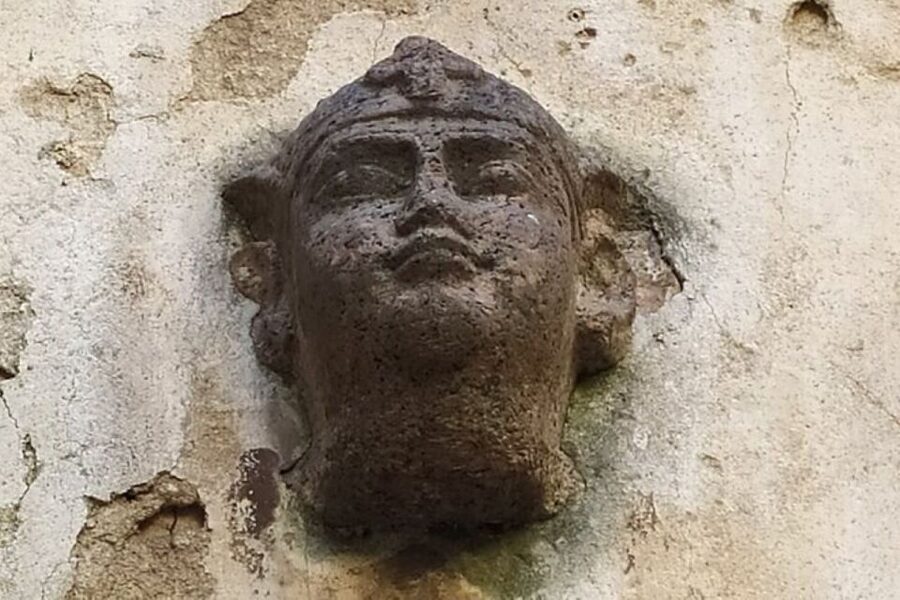
Split is famous for looking like a place frozen in time. The clever move here is that the tour treats the UNESCO site as a live monument, not a museum room you pass through.
You’ll spend most of your time inside the palace, then connect that Roman core to later medieval and modern Split. That’s what makes the whole experience feel practical: you learn how the city is built, why it’s built that way, and how people have kept using the space long after the original empire faded.
The guiding approach is built around a “see, hear and feel” style. The “see” part is obvious when you’re standing in the right spot, but the “hear” and “feel” parts come from the stories, legends, and everyday-life context your guide adds as you walk. It turns a tight route into something that sticks.
More History Tours in Split
- Walking Tour of Split with a ‘Magister’ of History
★ 5.0 · 1,122 reviews - Split Walking Tour with Professor of History
★ 5.0 · 926 reviews - Split: History and Heritage Walking Tour
★ 4.9 · 650 reviews
Golden Gate Orientation and Gregory of Nin, Your Split Cheat Sheet
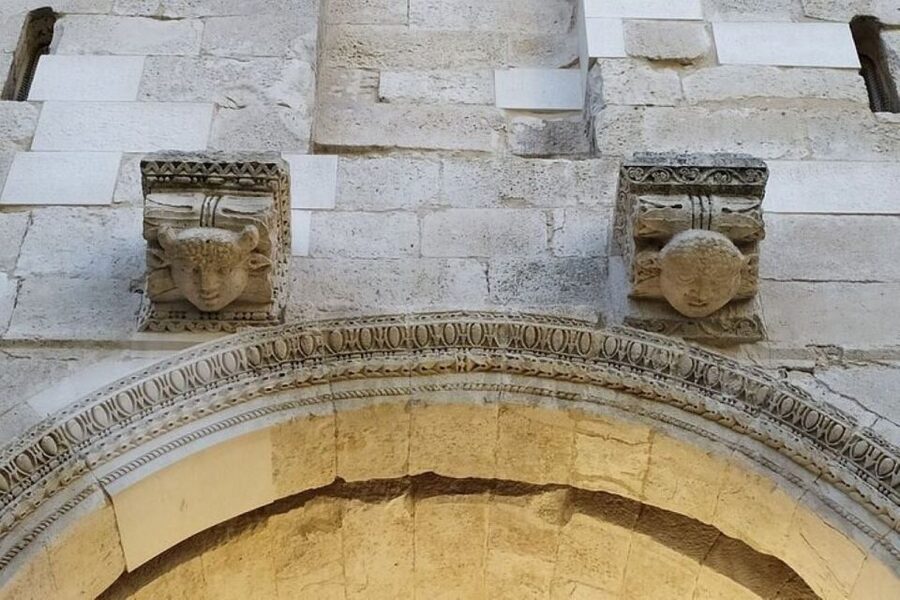
Your tour starts at the Golden Gate, the northern gate of Diocletian’s Palace. Meeting there is a gift, because it gives you the correct mental map before you step inward like you’re entering from the same direction as the original palace traffic.
Right at the start, you should expect a focused intro to Split and Croatia, then a history of the Golden Gate itself: what the name means, what its purpose was, and why it matters in the palace’s layout. Even if you normally skip prefaces, this one helps, because it shapes how you interpret everything you see next.
Another quick win is the proximity to the big statue of Gregory of Nin. You’ll learn about who he was and why his figure is still part of Split’s identity. It’s the kind of landmark lesson you’ll appreciate later, when you notice how locals and visitors respond to that area.
Timing is tight here, but it’s efficient. In about the first quarter hour you get orientation, then you move into the palace without wasting time.
Entering the Palace: Peristil and the Main Square Feeling
Once you cross into the palace, the tour shifts from “where are we?” to “what did this room do?” That matters, because Diocletian’s Palace can feel maze-like if you’re just wandering.
A big highlight is the Peristil, the main palace square. This is where the palace stops being abstract. Your guide will point out the monumental scale around you, then layer on stories, facts, legends, and intrigue connected to the spaces you’re seeing.
You’ll also get guided stops around key palace elements that help you understand how the emperor’s world was organized. Among the spaces you’ll pass through are the Jupiter’s Temple, the Cathedral of Saint Domnius, and several interiors and transitional areas like the Vestibule. Each stop helps you connect architecture to purpose, not just date it and move on.
One practical benefit: the pace is designed for seeing details you’d miss alone. You don’t need to be a Roman-history nerd. You just need to look where your guide tells you to look, then let the context do the rest.
Jupiter’s Temple and Saint Domnius Cathedral: From Emperor to Community
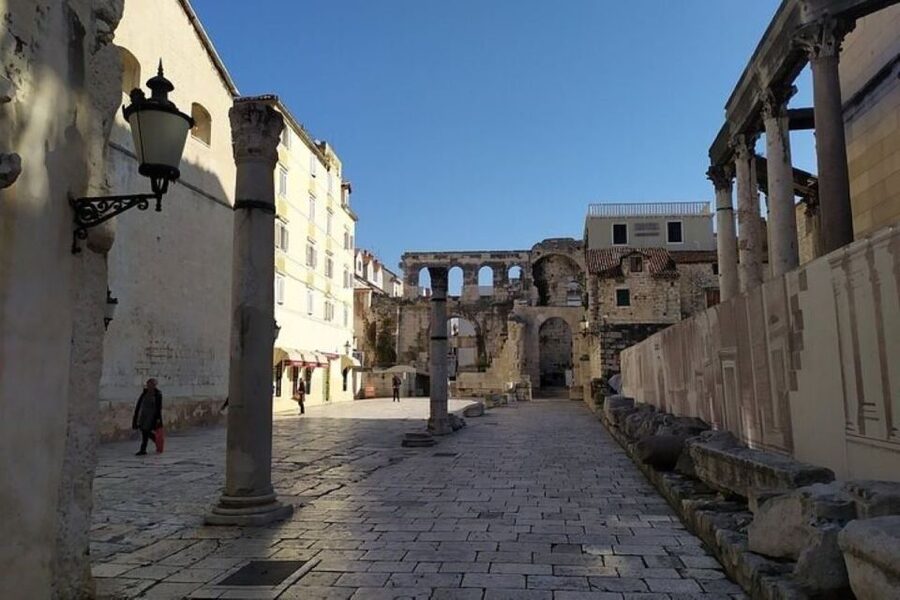
Inside the palace, the Jupiter’s Temple section is where the Roman side becomes crystal clear. You’ll learn what the temple represented and how that religious space fit into the palace’s power structure.
Then the tour brings you to the Cathedral of Saint Domnius, which is a key moment for understanding how Split changes without fully deleting its past. The point isn’t that one era is better than the other. The point is continuity: spaces get repurposed, names shift, and meaning evolves.
If you like history that explains modern life, you’ll probably enjoy this part most. You see how a place meant for one belief system becomes important to another, and you start to understand why Split feels layered rather than simply ancient.
More Walking Tours in Split
- Split: Old Town and Diocletian Palace Walking Tour
★ 4.9 · 4,727 reviews - Walking Tour of Split and Diocletian’s Palace
★ 5.0 · 2,588 reviews - Krka Waterfalls tour with Trogir Walking tour and Krka panoramic boat cruise
★ 5.0 · 1,659 reviews - Split & Diocletian’s Palace Walking Tour
★ 5.0 · 1,125 reviews
Diocletian’s Cellars and Vestibule: Learning What You Cannot Easily See
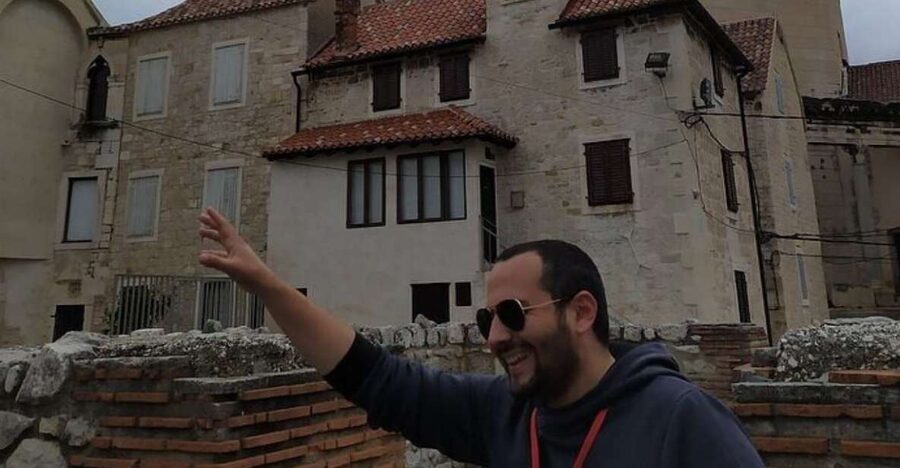
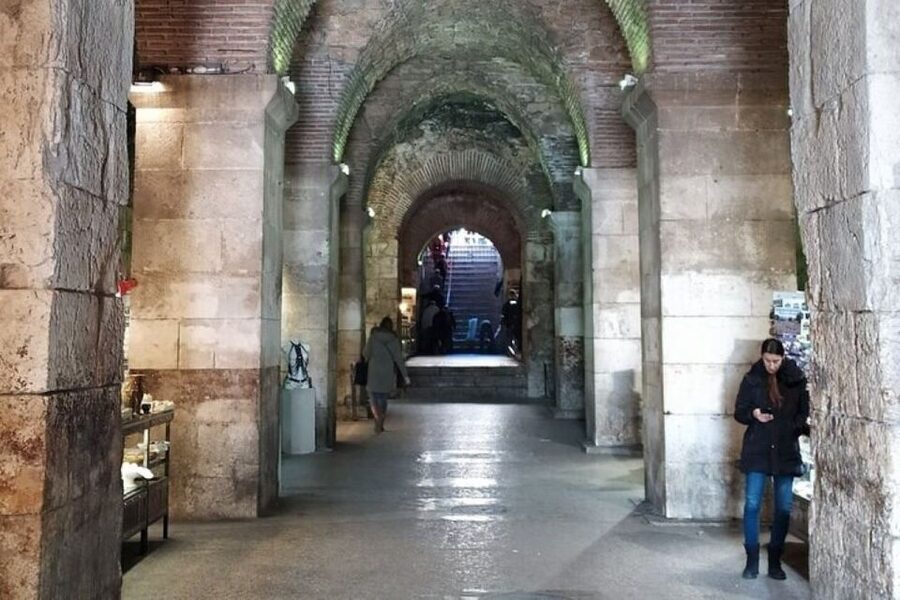
The palace can look like it’s all public spaces on top. The tour corrects that impression by taking you into the Diocletian’s Cellars area and other internal zones like the Central Substructures, also referred to as central cellars.
This is where the 2-hour format earns its keep. You get stops that many self-guided walks skip, because people don’t always know where to look or what they’re looking at. Here, your guide provides the “why,” so the under-structure spaces become part of the story rather than an odd detour.
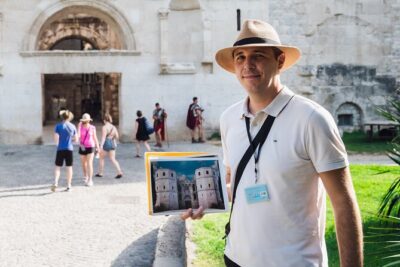
The guide also uses 3D reconstruction images and pictures in a display book. That’s valuable because some details you want to understand are hard to visualize from what’s still standing. With reconstructions, you can form a more complete picture of how spaces may have looked when they were in use.
The Vestibule stop fits the same theme. Transitional areas often tell you more than you expect, because they reveal how movement through power spaces worked. You’ll hear how these in-between spaces connect to the larger palace plan.
The Riva Promenade Connection, Roman Walls Meet Daily Life
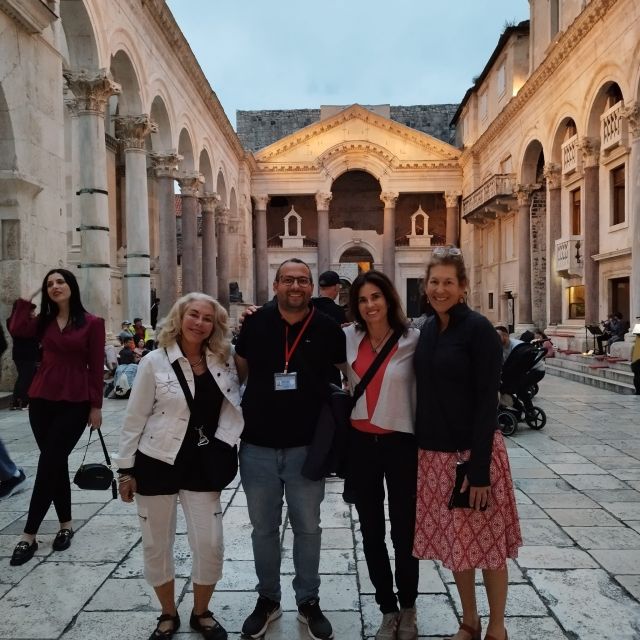
After walking through the palace core, the tour links you to the Riva promenade. This is a small but important change of pace.
You’re not just learning about emperors now. You’re learning about a city that keeps living in the same physical space. The guide connects the Roman and Medieval periods of Split here, then points out how you can observe that connection as you stand and walk along the waterfront.
This segment works well if you like practical travel. You get a sense of where the city’s energy lives, and you can use that understanding later when you choose where to linger after the tour.
Even though it’s only a short stop, it changes how you feel about the palace. The palace stops being a closed chapter and becomes the foundation under today’s street.
Fruit Square and People’s Square: Two Medieval “Rooms” of Split
Two medieval squares are built into the route: Fruit Square and People’s Square. Think of them as outdoor rooms. They’re not just postcard stops. They’re where architecture and crowd behavior meet.
You’ll learn about the secrets these squares hide in their architecture and the happenings connected to them over the centuries. The idea is to train your eye to notice features that you might otherwise ignore, like how buildings shape movement and how space influences social life.
The tour also keeps one theme consistent: Split is not only monuments and legends. Your guide includes everyday topics so you understand local life, community, and how people experience the city now, not just how it looked long ago.
If you enjoy “what it’s like to live here,” this part delivers.
Secret Stops, Narrow Corners, and the Sphinx Head Story
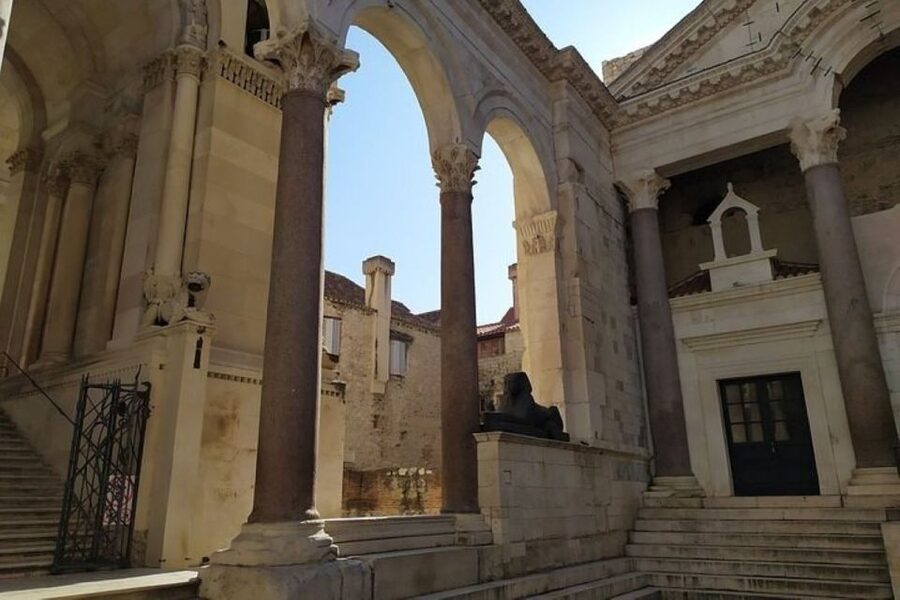
One chunk of the experience is reserved for smaller, more curious places you likely wouldn’t find on your own. The tour mentions chances to hear about hidden corners such as the narrowest church and narrowest street, plus stories tied to a lost sphinx head and a secret garden.
This is where the “see, hear and feel” approach becomes real. You’ll likely spend more time listening than photographing, and that’s the point. Your guide helps you picture what’s special about these spots, even if they look simple at first glance.
The best part about these secret-style stops is that they don’t waste time. They add color and personality to the palace narrative, reminding you that Split’s charm comes from the small scale too, not only the big famous structures.
Price and Value: Is 2 Hours for $37 Worth It?
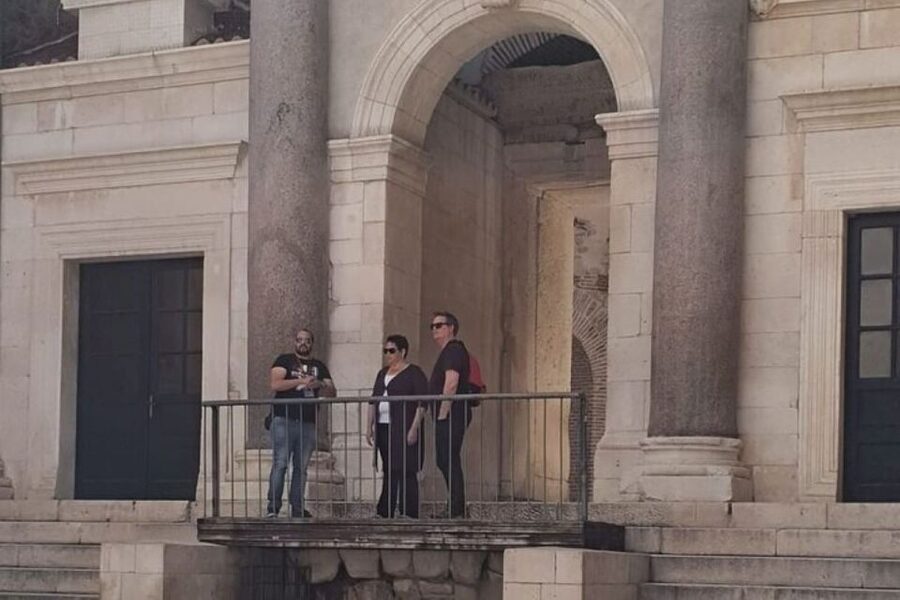
At $37 per person for a 2-hour guided walk, the value mostly comes from focus and format.
First, you’re not paying for a general sightseeing loop. You’re getting a licensed local guide with a master’s degree in history, plus 3D reconstruction images. That combination helps you understand harder-to-see structures and get more from the same landmarks you might otherwise treat like photo backdrops.
Second, the group size is capped at 12 participants. That usually means you can ask questions without feeling like you’re shouting over a crowd. In tight palace spaces, that matters.
Third, the tour includes skip-the-ticket-line. That keeps the time on the ground for learning, not waiting.
So yes, you’re paying for expertise. But you’re also paying for efficiency, because the route covers major palace spaces plus key city squares in only two hours.
Pace, Comfort, and Who This Walking Tour Fits Best
This is a walking tour, and it takes place mainly on palace stone. Bring comfortable shoes. Bring water, and on sunny days plan a hat or cap.
It is specifically listed as not suitable for wheelchair users and people with mobility impairments. If you’re able-bodied but prone to slipping on uneven stone, you’ll still want to take care and go slow at steps and narrow areas.
On the other hand, it’s a strong fit if you:
- Want a quick, structured way to understand Diocletian’s Palace without getting lost
- Like stories that connect Roman architecture to medieval and modern street life
- Prefer small-group tours where your questions get real answers
Language options are English and Croatian, so you can match what you feel most comfortable with while you listen.
Should You Book This Split History Walk?
Book it if you want Split to make sense fast. This tour is built for orientation and interpretation, not just landmark coverage. Starting at Golden Gate, learning about Gregory of Nin immediately, and then moving through Peristil, Saint Domnius Cathedral, Jupiter’s Temple, and the cellars gives you a strong storyline in a short time.
Skip it if you hate walking on stone or you need an accessibility-friendly route. The tour is not listed for wheelchair users, and the palace setting is likely to be difficult for anyone who needs smoother surfaces.
If you’re the kind of traveler who likes to understand why a place looks the way it does, you’ll probably leave with two things: better direction in Split, and a deeper feel for how Roman power, medieval reuse, and modern life all share the same streets.
In short, this is one of the better ways to understand the palace and still feel like you’re experiencing a living city.
More Historical Tours in Split
- Split History and Gastro Small-Group Tour with Food and Drinks
★ 5.0 · 375 reviews - SPLIT-PREMIUM Emperor’s Walking Tour for History Lovers + Museum
★ 5.0 · 333 reviews - Split: Local History and Culture 90-Minute Walking Tour
★ 5.0 · 194 reviews - Split: Historical & Gastro Treasures Tour with Green Market
★ 4.9 · 144 reviews
Newest Split reviews on the site
- Split: Blue Lagoon Boat Trip with Lunch, Wine and Snorkeling★ 5.0 · 3 reviews
- Split: Guided Sunset Sea Kayaking & Snorkeling Tour★ 4.8 · 185 reviews
- Split: Sunset Guided Kayaking Tour★ 4.8 · 71 reviews
- Sunset Cruise With Music and Views of Split Riviera★ 3.6 · 10 reviews
- Step into History: Private Guided Walking Tour of Split★ 5.0 · 3 reviews
- Stand Up Paddle Tour in Split★ 4.7 · 17 reviews
- Split&Sip: Educational wine tasting★ 4.9 · 52 reviews
- Split Walking Tour with History Professor★ 5.0 · 23 reviews
Historical Tours, compared.
Walking Tour of Split with a ‘Magister’ of History
Read our review →


Split History and Gastro Small-Group Tour with Food and Drinks
Read our review →Browse the lists this tour appears in